ARA-290
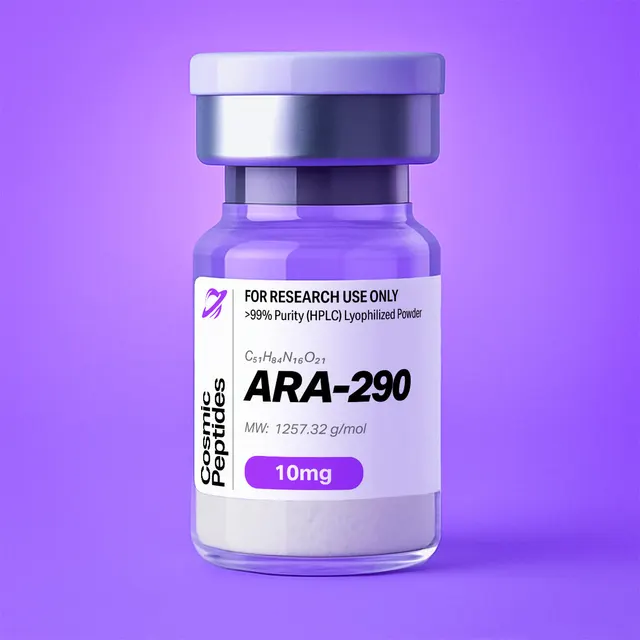
ARA-290
Commonly researched with these items
Patent-pending lot tracking: Complete transparency from production to vial.
ARA-290 (Cibinetide): An Eleven-Residue Mimetic of the Solvent-Exposed Face of Erythropoietin Helix B
Disclaimer
Products described here are supplied for research use only and are not intended for diagnostic, therapeutic, or clinical application. All statements regarding biological activity reflect preclinical and in vitro findings exclusively and have not been evaluated by the U.S. Food and Drug Administration. These materials and related content are provided for educational and investigational purposes only and are intended solely for qualified researchers in laboratory and academic settings.
Key Facts
- Compound class
- Linear undecapeptide; non-erythropoietic structural mimetic designed from the tertiary structure of erythropoietin (EPO). International non-proprietary name cibinetide; also designated pHBSP (pyroglutamate helix B surface peptide) and ARA290 in the literature.
- Sequence
H-Pyr-Glu-Gln-Leu-Glu-Arg-Ala-Leu-Asn-Ser-Ser-OH, commonly abbreviated pGlu-EQLERALNSS. All eleven α-carbons are in the L (S) configuration; the N-terminal residue is pyroglutamate, a cyclic lactam.- Molecular formula
- C51H84N16O21
- Molecular weight
- 1257.3 g/mol (average); monoisotopic mass 1256.5997 Da
- CAS number
- 1208243-50-8
- PubChem CID
- 91810664
- Other identifiers
- UNII 9W5677JKDA; ChEMBL CHEMBL3545305
- Ionization
- Net charge approximately −2 at pH 7.4; calculated isoelectric point near 3.5. ARA-290 is an acidic peptide, unlike the majority of short research peptides.
- Physical form as supplied
- Lyophilized powder
- Lot traceability
- Every unit is tied to a tracked lot; the lot number, recorded purity and verified quantity of the lot on sale are shown live on this page, with its certificate of analysis.
Molecular Identity and Classification
ARA-290 is a synthetic linear undecapeptide with the sequence H-Pyr-Glu-Gln-Leu-Glu-Arg-Ala-Leu-Asn-Ser-Ser-OH. It carries the international non-proprietary name cibinetide, is registered under CAS number 1208243-50-8, and appears in PubChem as compound 91810664, in the FDA substance registry under UNII 9W5677JKDA and in ChEMBL as CHEMBL3545305. The primary literature also calls it ARA290, pHBSP and the pyroglutamate helix B surface peptide; these aliases matter when searching, because papers predating the non-proprietary name use them almost exclusively.
The molecular formula is C51H84N16O21, giving an average molecular weight of 1257.3 g/mol and a monoisotopic mass of 1256.5997 Da. Both values are reproduced independently by residue summation: the eleven residue formulas add to C51H82N16O20, and adding the one molecule of water that completes a linear peptide (H2O) gives C51H84N16O21 exactly. Note that pyroglutamate contributes C5H5NO2 rather than the C5H7NO3 of a glutamate residue, because cyclisation of the side-chain carboxyl onto the α-amino nitrogen expels a molecule of water.
One notational point recurs in supplier documentation across the industry. Writing the sequence as H-Pyr-… follows the convention in which H- marks a free N-terminus, but pyroglutamate has no free α-amino group at all: its nitrogen is the ring nitrogen of a 5-oxopyrrolidine (γ-lactam), a tertiary amide that is neither basic nor a hydrogen-bond donor. The exact rendering is Pyr-Glu-Gln-Leu-Glu-Arg-Ala-Leu-Asn-Ser-Ser-OH, or 5-oxo-L-Pro-… using the first residue's systematic name. The -OH is accurate and consequential: the C-terminus is a free carboxylic acid, not an amide.
ARA-290 is therefore classified as a designed peptidomimetic of a protein surface, not a proteolytic fragment of a natural protein: as the next section shows, the common description of it as an eleven-amino-acid fragment of erythropoietin is incorrect as a statement about primary sequence.
Structure and Chemical Features
Three chemical features dominate this molecule: a blocked, conformationally restrained N-terminus; a strongly anionic side-chain complement; and the absence of the aromatic and sulfur-containing residues that create most of the analytical and stability liabilities of larger peptides.
The N-terminal pyroglutamate is a five-membered lactam formed between the γ-carboxyl and the α-nitrogen of a glutamate (or glutamine) residue. Because the α-nitrogen is consumed in the ring, the peptide presents no free N-terminal amine. Chemically this has three consequences. The molecule loses one of the two ionisable groups that normally define a peptide's amphoteric character, so its charge behaviour is governed almost entirely by its acidic side chains. The ring removes the substrate feature that aminopeptidases recognise, so the N-terminus is intrinsically resistant to that class of exopeptidase. And the ring is rigid, with the C2 substituent held in a defined orientation relative to the first amide bond, so the peptide's N-terminal end is conformationally restrained in a way a free glutamate would not be.
The side-chain inventory is: two glutamate carboxylates (positions 2 and 5), one glutamine carboxamide (position 3), one arginine guanidinium (position 6), one asparagine carboxamide (position 9), two serine hydroxymethyl groups (positions 10 and 11), two leucine isobutyl groups (positions 4 and 8) and one alanine methyl group (position 7). There is no cysteine, so no disulfide chemistry and no thiol oxidation; no methionine, so no sulfoxide formation; and no tryptophan, tyrosine or phenylalanine, so no aromatic chromophore and no photochemical or oxidative liabilities associated with those residues. The only hydrophobic elements are the two leucines and the single alanine, which is why the molecule is strongly hydrophilic overall.
Ionization and Net Charge
Counting ionisable groups gives one strongly basic site (the arginine guanidinium, pKa near 12.5) against three acidic sites (two glutamate carboxylates near pKa 4.25 and the C-terminal carboxylic acid near pKa 3.2). Because the pyroglutamate blocks what would otherwise be a basic N-terminal amine, the acidic groups are not balanced. Summing the Henderson–Hasselbalch contributions gives a net charge of approximately +0.9 at pH 2, crossing zero near pH 3.5, reaching about −1.7 at pH 5 and plateauing at approximately −2.0 from pH 6 upward. The calculated isoelectric point is therefore about 3.5, and at any physiological or standard buffer pH ARA-290 exists as a dianion.
This single fact inverts several habits carried over from work on basic peptides. ARA-290 binds weakly or not at all to cation-exchange resins at neutral pH and is retained on anion exchangers instead; it carries a small rather than a large trifluoroacetate burden after reversed-phase purification, because there is only one basic site to pair with; and it is repelled by, rather than attracted to, the negatively charged surfaces that adsorb cationic peptides. In negative-mode electrospray it ionises efficiently, which gives analysts a genuine choice of polarity.
Relationship to Erythropoietin Helix B
ARA-290 is routinely described as being derived from the aqueous, solvent-exposed face of helix B of erythropoietin. The structural logic behind that description is sound, but it is often compressed into the claim that the peptide is a contiguous eleven-residue stretch of the EPO chain, and that claim does not survive checking. In the UniProt entry for human erythropoietin (P01588), the mature chain spans positions 28–193 of the precursor, giving a 166-residue polypeptide. Searching that chain for the string QEQLERALNSS returns no match; the closest eleven-residue window shares only four residues with it. Helix B — mature residues 58–82 in the numbering the originating work uses, inside the helix that the same UniProt entry annotates at precursor residues 83–109, equivalently mature 56–82 — reads Gln-Gln-Ala-Val-Glu-Val-Trp-Gln-Gly-Leu-Ala-Leu-Leu-Ser-Glu-Ala-Val-Leu-Arg-Gly-Gln-Ala-Leu-Leu-Val, and the tripeptide Asn-Ser-Ser that terminates ARA-290 corresponds to mature residues 83–85, immediately C-terminal to the helix.
What ARA-290 reproduces, then, is not a sequence but a surface. A helix presents roughly 3.6 residues per turn, so the residues that face solvent on one side of helix B are separated in the primary sequence by three or four positions while being adjacent in space. Gathering the polar residues of that face — the glutamines, the glutamates and the arginine — onto a single short chain, and appending the Asn-Ser-Ser that follows the helix, produces a peptide whose side-chain presentation approximates the exposed face while bearing little linear resemblance to the parent. This is the sense in which the originating publication, by Brines and colleagues in 2008, describes the peptides as derived from the tertiary structure of erythropoietin rather than from its sequence. The structural basis for identifying that face in the first place came from the solution and crystal structures of EPO and its receptor complex determined in 1998 by Cheetham and colleagues and by Syed and colleagues.
A short linear peptide in water does not hold a helical conformation: circular dichroism of undecapeptides of this composition is dominated by random-coil character, and nothing here implies that ARA-290 is helical in solution. The design premise is only that it can sample a conformation presenting the right side-chain constellation.
Synthesis and Manufacturing Chemistry
ARA-290 is prepared by solid-phase peptide synthesis, the approach introduced by Merrifield in 1963, in which the chain is assembled stepwise on an insoluble polymer support so that excess reagents and soluble by-products are removed by filtration. Contemporary manufacture uses the Fmoc/tBu strategy built on the 9-fluorenylmethoxycarbonyl protecting group described by Carpino and Han in 1972: each incoming residue carries a base-labile Fmoc group on its α-nitrogen, removed with piperidine in dimethylformamide, while side-chain protection is acid-labile and survives until final cleavage.
Because the target carries a free C-terminal acid, synthesis starts from a serine loaded onto an acid-labile linker such as 2-chlorotrityl chloride or a Wang-type handle, and the chain is extended from the C-terminus toward the N-terminus. The protected building blocks for this sequence are Fmoc-Ser(tBu)-OH, Fmoc-Asn(Trt)-OH, Fmoc-Leu-OH, Fmoc-Ala-OH, Fmoc-Arg(Pbf)-OH, Fmoc-Glu(OtBu)-OH, Fmoc-Gln(Trt)-OH and, for the final position, either Fmoc-Pyr-OH or the unprotected pyroglutamic acid, which needs no α-protection precisely because its nitrogen is already in the lactam ring. Couplings are driven by a carbodiimide with an oxime additive, typically DIC with Oxyma, characterised by Subirós-Funosas and colleagues in 2009 as a lower-risk replacement for benzotriazole additives, or by uronium salts such as HBTU or HATU.
Four sequence-specific points govern the quality of the crude product. First, a liability this sequence conspicuously lacks. Aspartimide formation — base-catalysed attack of a backbone nitrogen on a protected side-chain ester to give a five-membered imide that reopens as the β-linked isomer or racemises — is the dominant piperidine-driven side reaction in Fmoc chemistry, and it requires an aspartate. ARA-290 contains none. Its two glutamates can in principle close to the six-membered glutarimide analogue, but ring closure onto a side chain one carbon longer is far slower, so this sequence tolerates repeated deprotection cycles unusually well; the reaction and its mitigations were reviewed by Subirós-Funosas, El-Faham and Albericio in 2011. Second, the Asn-Ser-Ser C-terminal motif is the most deamidation-prone element of the molecule, and the asparagine is therefore protected on its carboxamide (as the trityl derivative) to suppress dehydration to a nitrile during activation. Third, arginine's guanidinium requires the Pbf group, whose removal is the slowest step of the final acidolysis and the usual reason extended cleavage times are needed. Fourth, the serine-rich C-terminus keeps the growing chain polar and aggregation-free, so the synthesis rarely needs elevated temperature or chaotropic additives to maintain coupling efficiency.
Final cleavage uses trifluoroacetic acid with scavengers, commonly water and triisopropylsilane with a thiol or thioanisole component to capture the Pbf and trityl cations, and simultaneously removes the tert-butyl esters and ethers. The crude peptide is precipitated into cold diethyl ether, then purified by preparative reversed-phase HPLC and lyophilized. Because only the arginine is basic, the isolated trifluoroacetate salt carries at most one counterion per molecule, and many producers exchange it for acetate or convert the material to a sodium salt; the certificate of analysis accompanying each lot records the salt form and the analytical results that apply to that specific material.
Analytical Characterization
Identity and purity are established by complementary techniques, and this composition makes several standard assumptions inapplicable.
Reversed-phase HPLC is the primary purity assay. Detection must be in the peptide-bond region, 210–220 nm, because the molecule contains no tryptophan, tyrosine or phenylalanine and therefore has negligible absorbance at 280 nm; an analyst who sets up a 280 nm method will see essentially nothing, and concentration cannot be established spectrophotometrically at all. Chromatographically, the combination of high polarity and a net negative charge at neutral pH means that a C18 method run with 0.1% trifluoroacetic acid gives better retention than a neutral or basic mobile phase, since protonating the carboxylates suppresses their charge; practical gradients begin at low organic content, for instance 5–35% acetonitrile. General considerations for peptide HPLC method development are set out by Mant and colleagues.
Expected Mass Spectrometric Ions
Mass spectrometry confirms identity, and because ARA-290 has one basic site and three acidic sites, both polarities are informative. In positive-mode electrospray the calculated ions are [M+H]+ at m/z 1257.607, [M+2H]2+ at m/z 629.307 and [M+3H]3+ at m/z 419.874, with the singly and doubly charged species usually dominant; the 3+ ion is weak because there is only one strongly basic residue to carry charge. In negative mode the calculated ions are [M−H]− at m/z 1255.592 and [M−2H]2− at m/z 627.293, and the dianion is typically strong, reflecting the two glutamates. All values are calculated from the monoisotopic mass 1256.5997 Da using a proton mass of 1.00728 Da.
Tandem mass spectrometry gives a fragment pattern shaped by the arginine at position 6, which sequesters the mobile proton and biases cleavage toward the amide bonds nearest to it; the general principles are reviewed by Paizs and Suhai. Calculated singly protonated b and y ions for the full series are b2 241.082, b3 369.140, b4 482.225, b5 611.267, b6 767.368, b7 838.405, b8 951.489, b9 1065.532 and b10 1152.564, with y2 193.082, y3 307.125, y4 420.209, y5 491.246, y6 647.347, y7 776.390, y8 889.474, y9 1017.532 and y10 1146.575. The y6 ion at 647.347, which contains the arginine, is a reliable anchor for sequence confirmation. The b1 ion at 112.039 is unusual in being observable at all: ordinary b1 ions are not, but an N-terminal pyroglutamate is already cyclised and so gives a stable acylium-equivalent species, making 112.039 a useful diagnostic for the pyroglutamate N-terminus. The same ring can form spontaneously at an N-terminal glutamine or glutamate, and the deliberate version of that conversion is used to homogenise ragged N-termini before characterisation, as described by Xu and colleagues in 2013. In ARA-290 the lactam is installed by design, so the N-terminus occupies one defined state from the outset rather than drifting between cyclised and open forms over a stock solution's lifetime — a mass-spectrometric simplification that peptides beginning in free Gln do not enjoy.
Purity, Peptide Content and the Deamidation Satellite
Purity and peptide content are different quantities and both belong on a certificate of analysis. HPLC purity is the fraction of the UV-absorbing material that is the target peptide. Peptide content is the fraction of the weighed powder that is peptide at all, the remainder being counterions, bound water and residual salts. For ARA-290 the counterion burden is modest because only the arginine is basic: a mono-trifluoroacetate salt has a formula weight of 1371.3 g/mol and a peptide content of 91.7% by weight, while a disodium salt sits near 1301.3 g/mol and 96.6%. A dibasic peptide of similar size carries two trifluoroacetates and a correspondingly larger mass penalty. Peptide content is determined by amino-acid analysis or quantitative NMR; counterion level by ion chromatography or 19F NMR; water by Karl Fischer titration.
Amino-acid analysis of ARA-290 has one feature that surprises first-time analysts. Acid hydrolysis converts glutamine to glutamate and asparagine to aspartate, and it also opens the pyroglutamate ring to give glutamate. The expected molar ratios are therefore Glx 4, Ser 2, Leu 2, Ala 1, Arg 1 and Asx 1 — a total of eleven residues in which four of the eleven report as glutamate even though the sequence contains only two glutamate residues. Serine is partially destroyed under standard hydrolysis conditions, so recoveries below the nominal 2.0 are expected rather than evidence of a defect.
The most important impurity to look for is the deamidated form. Asparagine followed by a small residue is a classic deamidation motif, proceeding through a cyclic succinimide intermediate that hydrolyses to aspartate or iso-aspartate, as established by Geiger and Clarke in 1987 and quantified across sequence contexts by Robinson and Robinson in 2001. In ARA-290 the Asn9-Ser10 pair is exactly such a motif. Deamidation adds 0.984 Da, so the product appears as a +1 Da satellite with calculated [M+H]+ at m/z 1258.591, and as a closely eluting shoulder on the main HPLC peak that is often better resolved at mildly acidic pH or on a different stationary-phase chemistry. A method that cannot separate a +1 Da species from the parent will report the deamidated material as pure target, which is the single most common analytical blind spot for this sequence.
Physicochemical Properties
| Property | Value | Notes |
|---|---|---|
| Molecular formula | C51H84N16O21 | Free acid, without counterions |
| Average molecular weight | 1257.3 g/mol | PubChem CID 91810664 |
| Monoisotopic mass | 1256.5997 Da | Basis for all calculated m/z values below |
| [M+H]+ / [M+2H]2+ / [M+3H]3+ | m/z 1257.607 / 629.307 / 419.874 | Positive ESI, calculated; 3+ weak (one basic residue) |
| [M−H]− / [M−2H]2− | m/z 1255.592 / 627.293 | Negative ESI, calculated; dianion usually strong |
| Deamidated form [M+H]+ | m/z 1258.591 | +0.984 Da; Asn9 to Asp or iso-Asp |
| Ionisable groups | 1 basic / 3 acidic | Arg guanidinium; 2 Glu carboxylates and C-terminal acid |
| Net charge at pH 7.4 | approximately −2 | Calculated; no free N-terminal amine (pyroglutamate) |
| Calculated isoelectric point | about 3.5 | Acidic peptide; anionic across the usual buffer range |
| XLogP3 | −7.7 | PubChem computed; strongly hydrophilic |
| Topological polar surface area | 623 Å2 | PubChem computed |
| Hydrogen-bond donors / acceptors | 20 / 22 | PubChem computed |
| Rotatable bonds | 42 | PubChem computed; highly flexible chain |
| Heavy atom count | 88 | PubChem computed |
| Stereocentres | 11 | All α-carbons L-configured; no glycine in the sequence |
| UV absorbance | Peptide bond only, about 214 nm | No Trp, Tyr or Phe; negligible signal at 280 nm |
| Aqueous solubility | Freely soluble in water and neutral buffers | Polyanionic and strongly hydrophilic |
| Mono-TFA salt / peptide content | 1371.3 g/mol / 91.7% | Calculated; one basic site pairs one counterion |
| Oxidation-sensitive residues | None | No Cys, Met, Trp or Tyr |
| Principal degradation route | Asn9 deamidation | Succinimide-mediated; accelerated at neutral to basic pH |
The profile that emerges is of a small, very polar, flexible polyanion with an unusually clean stability picture. A calculated XLogP3 of −7.7 and a polar surface area of 623 Å2 rule out passive diffusion across a lipid bilayer, so any experiment in which the peptide appears to reach an intracellular compartment requires a transport or uptake mechanism to be identified rather than assumed. The 42 rotatable bonds place it in the conformationally disordered regime.
Against that, the absence of cysteine, methionine, tryptophan and tyrosine removes the oxidation and photodegradation pathways that dominate the stability of many peptides, while the blocked pyroglutamate N-terminus removes aminopeptidase susceptibility and the cyclisation routes open to peptides with free α-amines. In practice, ARA-290's stability is governed almost entirely by one reaction at one position: deamidation of Asn9.
Research Context
Research on ARA-290 is organised around a specific question in receptor biochemistry: whether the two activities historically attributed to erythropoietin can be separated at the level of receptor assembly, and whether a small synthetic molecule can engage one receptor arrangement without the other.
Receptor Architecture
Erythropoietin signals through the erythropoietin receptor (EPOR), a class I cytokine receptor. The structural work of the late 1990s established how exacting that interaction is: Syed and colleagues showed in 1998 that signalling efficiency through EPOR depends critically on the relative orientation of the two receptor chains, and Livnah and colleagues showed in 1999 that EPOR exists as a preformed dimer whose geometry is rearranged rather than created by ligand binding. Full-length EPO engages this homodimer through two non-equivalent interfaces on opposite faces of the folded cytokine, so engagement depends on the intact tertiary structure of the whole protein.
In 2004, Brines and colleagues reported that a second receptor assembly, a heteromeric complex of EPOR with the common beta receptor subunit (βcR, also designated CD131), accounts for a branch of EPO signalling separable from erythropoiesis. The same year, Leist and colleagues reported that chemically modified EPO derivatives without erythropoietic activity retained signalling through that branch; the modification was carbamylation, which converts lysine ε-amino groups into homocitrulline residues and so abolishes the positive charges the EPOR homodimer interface requires — evidence that the two activities rest on separable chemical determinants. Brines and Cerami later reviewed the heteromer, as a node in inflammatory signalling. ARA-290 was reported in 2008 as a minimal molecule designed on that premise: reproducing one surface of the cytokine, it lacks the structural elements needed to bridge the EPOR homodimer while presenting the side-chain constellation implicated in heteromer engagement.
In Vitro Read-Outs
The signalling events studied downstream of the EPOR/βcR complex in cell systems are the Janus kinase 2 (JAK2) pathway and its STAT5 substrate, the phosphoinositide 3-kinase/Akt axis, and the NF-κB system. Nairz and colleagues reported in 2017 that cibinetide suppresses the activity of the NF-κB p65 subunit in myeloid cell systems in a manner dependent on both CD131 and JAK2, with corresponding reductions in the transcriptional output of that pathway including tumour necrosis factor, interleukin-6 and inducible nitric oxide synthase. The CD131 dependence is the methodologically important part: an effect that disappears in cells lacking the subunit is attributable to the receptor rather than to a non-specific property of a polyanionic peptide.
Standard in vitro designs in this area combine a cytokine or stress stimulus with a concentration–response series for the peptide, typically spanning low nanomolar to low micromolar. Read-outs include immunoblotting for phosphorylated JAK2, STAT5 and Akt; NF-κB reporter-gene assays or immunofluorescence tracking of p65 nuclear translocation; quantification of secreted cytokines by ELISA or multiplex bead assay; caspase 3/7 activity and ATP-based viability measurements in cells placed under oxidative or nutrient stress; and transcript-level confirmation by quantitative PCR. Receptor attribution is established by comparing cells that express CD131 with cells in which it is absent or knocked down, and by testing a scrambled-sequence peptide of identical composition alongside the target.
Two controls deserve emphasis for this particular molecule. The first is counterion matching: trifluoroacetate carried over from purification has measurable effects on cultured cells, as Cornish and colleagues demonstrated in 1999, and a vehicle control matched for counterion content separates peptide effects from salt effects. The second is confirmation of integrity in the assay medium, since the deamidated species is a distinct chemical entity whose presence changes what has actually been added to the well.
Structural Comparison with Erythropoietin
| Feature | Erythropoietin | Helix B region | ARA-290 |
|---|---|---|---|
| Chain length | 166 residues (mature chain, precursor positions 28–193) | Mature residues 58–82, with Asn-Ser-Ser at 83–85 | 11 residues |
| Relationship | Parent cytokine | One helix of the four-helix fold | Designed mimetic of the solvent-exposed face; not a contiguous subsequence |
| Sequence identity to ARA-290 | No match for QEQLERALNSS in the mature chain | Shares the Asn-Ser-Ser motif at 83–85 | — |
| Glycosylation | N- and O-linked glycans | — | None |
| Defined tertiary structure | Yes; four-helix cytokine fold | Helical within the fold | No; conformationally disordered in solution |
| Aromatic chromophore | Present (Trp, Tyr, Phe) | Contains Trp64 | Absent; detection at 214 nm only |
| Production route | Recombinant expression in mammalian cell culture | — | Fmoc solid-phase peptide synthesis |
| Receptor assembly engaged in vitro | EPOR homodimer and EPOR/βcR heteromer | — | EPOR/βcR heteromer; no reported homodimer engagement |
| Analytical approach | Intact and peptide-mapping LC-MS, glycan analysis, bioassay | — | RP-HPLC at 214 nm, LC-MS, amino-acid analysis |
The table also shows why ARA-290 is a tractable laboratory reagent independently of any biological question: a chemically defined undecapeptide with no glycans, no disulfides, no oxidisable residues and one well-understood degradation route can be characterised completely by routine methods and reproduced between lots to a standard no glycoprotein can approach.
Related Compounds
ARA-290 belongs to a broader set of research peptides used to probe stress-response and inflammatory signalling in cell systems. Where a comparison is useful, the nearest analytical and mechanistic neighbours in this catalogue are the mitochondria-targeted tetrapeptide SS-31, which is studied for effects on mitochondrial membrane integrity and oxidative stress in cultured cells and which, as a polycationic peptide, makes an instructive electrostatic counterpoint to ARA-290's dianionic character; the mitochondrial-derived peptide MOTS-c; and the tripeptide KPV, which is used in epithelial cell models with the same NF-κB and cytokine read-outs described above and so can serve as an orthogonal reference compound in those assays.
Among immunomodulatory peptides characterised in vitro, Thymosin Alpha-1 and Thymalin are studied with overlapping cytokine-profiling methods, while LL-37 is the standard cationic host-defence reference. None shares ARA-290's receptor target; the comparison is methodological, since a panel spanning opposite charge states separates receptor-specific effects from the generic consequences of adding a charged polypeptide to a culture well.
Laboratory Handling and Storage
Storing the solid. Lyophilized ARA-290 is kept tightly closed at −20 °C or colder, protected from light and moisture. Lyophilized peptide powders are hygroscopic: a container opened straight from the freezer condenses atmospheric water, so equilibrating it to room temperature in a desiccator before opening protects both weighing accuracy and the stability of the remainder.
Dissolving and worked molar calculation. The compound dissolves readily in high-purity water and in neutral aqueous buffers such as phosphate-buffered saline, with no need for organic co-solvents. Because the molecule carries no 280 nm chromophore, concentration cannot be checked spectrophotometrically and must be established by mass. Working from the average molecular weight of 1257.3 g/mol: 1.00 mL of a 1.00 mM solution requires 1.2573 mg of peptide on a free-acid basis. If the lot's certificate of analysis reports a peptide content of 91.7% by weight, consistent with a mono-trifluoroacetate salt, the mass to weigh is 1.2573 ÷ 0.917 = 1.3711 mg. Conversely, 10.0 mg of free-acid-equivalent peptide is 7.95 µmol, which dissolved in 1.00 mL gives 7.95 mM. Skipping the peptide-content correction introduces an error of roughly 8% in every downstream concentration, larger than the effect sizes many assays are designed to resolve.
Stock solutions and pH. Stocks are usually prepared at 1–10 mM, passed through a 0.22 µm membrane when destined for cell culture, divided into single-use aliquots and stored at −80 °C. Repeated freeze–thaw cycles are best avoided. One point is specific to this sequence: because deamidation of Asn9 proceeds through a succinimide intermediate whose formation is base-catalysed, the reaction accelerates markedly as pH rises above neutrality. Stocks held briefly at mildly acidic pH, around 4 to 5, are chemically more stable than stocks held at pH 8, and long-term storage of aqueous solutions at ambient temperature should be avoided altogether in favour of frozen aliquots or the lyophilized solid.
Surfaces and adsorption. At low working concentrations, peptides can be lost to container surfaces. The usual advice to use low-binding polypropylene applies, but the electrostatics here run opposite to the common case: as a dianion at neutral pH, ARA-290 is repelled by the negatively charged surfaces that strongly adsorb cationic peptides, and is instead more prone to loss on positively charged or derivatised surfaces. Where the design permits, a carrier protein such as bovine serum albumin in dilute working solutions reduces surface losses.
Re-verification. After extended storage, an LC-MS check of a stock solution confirms both identity and integrity: the expected [M+H]+ at m/z 1257.607 or [M−H]− at m/z 1255.592 should be present, and the +1 Da species at 1258.591 should be absent or minor. Each lot's certificate of analysis, shown with the lot details on this page, records the analytical results for the specific material supplied.
Glossary
- Pyroglutamate (pGlu, Pyr, 5-oxoproline)
- A cyclic lactam formed when the side-chain carboxyl of a glutamate or glutamine closes onto its own α-nitrogen, losing water or ammonia. The resulting ring leaves no free α-amine, so a pyroglutamate N-terminus is neither basic nor accessible to aminopeptidases.
- Helix B surface peptide (HBSP, pHBSP)
- The literature designation for ARA-290, reflecting its design as a mimetic of the solvent-exposed face of helix B of erythropoietin. The leading "p" denotes the pyroglutamate form.
- Common beta receptor subunit (βcR, CD131)
- A shared signalling subunit of several cytokine receptors. In complex with the erythropoietin receptor it forms the heteromeric assembly studied as the EPOR–CD131 heteromeric receptor.
- Deamidation
- Loss of ammonia from an asparagine or glutamine carboxamide, in asparagine proceeding through a cyclic succinimide that hydrolyses to aspartate or iso-aspartate. The mass increases by 0.984 Da.
- Aspartimide formation
- A side reaction of solid-phase synthesis in which a backbone nitrogen attacks a protected side-chain ester to form a cyclic imide, which can reopen as the wrong regioisomer or with loss of stereochemistry.
- Peptide content
- The mass fraction of a lyophilized powder that is peptide, as distinct from counterions, bound water and salts. Required for accurate molar concentrations, and distinct from chromatographic purity.
- Monoisotopic mass
- The mass calculated from the lightest stable isotope of each element, as opposed to the average mass, which uses natural isotopic abundances. High-resolution instruments report monoisotopic values.
- Pbf, tBu, Trt
- Acid-labile side-chain protecting groups used in Fmoc synthesis: Pbf for the arginine guanidinium, tert-butyl esters and ethers for glutamate and serine, and trityl for the glutamine and asparagine carboxamides.
Frequently Asked Research Questions
- What is ARA-290?
- ARA-290, non-proprietary name cibinetide, is a synthetic linear undecapeptide with the sequence H-Pyr-Glu-Gln-Leu-Glu-Arg-Ala-Leu-Asn-Ser-Ser-OH. It was designed as a non-erythropoietic mimetic of the solvent-exposed face of helix B of erythropoietin. Its molecular formula is C51H84N16O21, its average molecular weight 1257.3 g/mol and its monoisotopic mass 1256.5997 Da.
- What is the CAS number of ARA-290?
- ARA-290 is registered under CAS number 1208243-50-8 and appears in PubChem as compound 91810664, under UNII 9W5677JKDA and as ChEMBL CHEMBL3545305. The literature aliases ARA290, cibinetide, pHBSP and helix B surface peptide all refer to the same molecule.
- Is ARA-290 a fragment of erythropoietin?
- No, not in the sense of primary sequence. Searching the mature human erythropoietin chain in UniProt entry P01588 for the string QEQLERALNSS returns no match, and the closest eleven-residue window shares only four residues with it. ARA-290 reproduces the constellation of side chains presented by one face of helix B, which is why the originating work describes it as derived from the tertiary rather than the primary structure. The C-terminal Asn-Ser-Ser does correspond to mature residues 83–85, immediately following helix B.
- Why does ARA-290 carry a negative charge when most research peptides are basic?
- Because its N-terminal pyroglutamate is a lactam with no free α-amine, the molecule has only one basic group, the arginine guanidinium, set against two glutamate carboxylates and a free C-terminal acid. The net charge is approximately −2 above pH 6 and the calculated isoelectric point is near 3.5. This affects ion-exchange behaviour, counterion load and surface adsorption.
- What masses should ARA-290 give by mass spectrometry?
- Calculated from the monoisotopic mass of 1256.5997 Da: in positive electrospray, [M+H]+ at m/z 1257.607, [M+2H]2+ at 629.307 and a weak [M+3H]3+ at 419.874; in negative mode, [M−H]− at 1255.592 and [M−2H]2− at 627.293. Negative mode works well because of the two glutamate residues.
- Why is there no absorbance at 280 nm?
- The sequence contains no tryptophan, tyrosine or phenylalanine, the residues responsible for absorbance near 280 nm. HPLC detection must use the peptide-bond region at 210–220 nm, and concentration cannot be determined spectrophotometrically; it must be established gravimetrically with a peptide-content correction or by amino-acid analysis.
- What is the main degradation route for ARA-290?
- Deamidation of Asn9, which sits in an Asn-Ser motif and proceeds through a cyclic succinimide intermediate to aspartate or iso-aspartate. The product is 0.984 Da heavier, appearing as a calculated [M+H]+ at m/z 1258.591 and as a closely eluting HPLC shoulder. The reaction is base-catalysed, so neutral-to-basic aqueous storage accelerates it.
- Why do four residues report as glutamate in amino-acid analysis?
- Acid hydrolysis converts glutamine to glutamate and also opens the pyroglutamate ring to glutamate. With two glutamate residues already present, the expected Glx value is 4. The full expected ratios are Glx 4, Ser 2, Leu 2, Ala 1, Arg 1 and Asx 1, with serine recovery typically below nominal because it is partially destroyed during hydrolysis.
- How much powder is needed for a 1 mM solution?
- On a free-acid basis, 1.2573 mg in 1.00 mL gives 1.00 mM. If the certificate of analysis reports 91.7% peptide content, consistent with a mono-trifluoroacetate salt, weigh 1.3711 mg instead. Equivalently, 10.0 mg of free-acid-equivalent peptide is 7.95 µmol.
- Which receptor assembly is studied with ARA-290 in vitro?
- The heteromeric complex of the erythropoietin receptor with the common beta receptor subunit (βcR, CD131), described by Brines and colleagues in 2004 and reviewed as the EPOR–CD131 heteromeric receptor. Because ARA-290 reproduces only one surface of the parent cytokine, it lacks the elements needed to bridge the EPOR homodimer that mediates erythropoiesis.
- Which controls matter most in cell-based work with ARA-290?
- Three. A counterion-matched vehicle control, because trifluoroacetate alone affects cultured cells. A CD131-deficient or knocked-down comparison, to attribute an effect to the receptor rather than to a polyanionic peptide. And an LC-MS integrity check of the working solution, since the deamidated species is a different chemical entity from the target.
- Where can I see the purity of the material I am buying?
- This page shows the lot number, recorded purity and verified quantity of the lot currently on sale, live from the shop's lot database, with that lot's certificate of analysis.
Sources & Further Reading
- National Center for Biotechnology Information. PubChem Compound Summary for CID 91810664, Cibinetide. PubChem CID 91810664.
- UniProt Consortium. Erythropoietin, Homo sapiens. UniProt Knowledgebase entry P01588.
- Brines M, Patel NSA, Villa P, et al. Nonerythropoietic, tissue-protective peptides derived from the tertiary structure of erythropoietin. Proceedings of the National Academy of Sciences 2008;105(31):10925–10930. doi:10.1073/pnas.0805594105
- Brines M, Grasso G, Fiordaliso F, et al. Erythropoietin mediates tissue protection through an erythropoietin and common β-subunit heteroreceptor. Proceedings of the National Academy of Sciences 2004;101(41):14907–14912. doi:10.1073/pnas.0406491101
- Leist M, Ghezzi P, Grasso G, et al. Derivatives of erythropoietin that are tissue protective but not erythropoietic. Science 2004;305(5681):239–242. doi:10.1126/science.1098313
- Syed RS, Reid SW, Li C, et al. Efficiency of signalling through cytokine receptors depends critically on receptor orientation. Nature 1998;395(6701):511–516. doi:10.1038/26773
- Cheetham JC, Smith DM, Aoki KH, et al. NMR structure of human erythropoietin and a comparison with its receptor bound conformation. Nature Structural Biology 1998;5(10):861–866. doi:10.1038/2302
- Livnah O, Stura EA, Middleton SA, Johnson DL, Jolliffe LK, Wilson IA. Crystallographic evidence for preformed dimers of erythropoietin receptor before ligand activation. Science 1999;283(5404):987–990. doi:10.1126/science.283.5404.987
- Brines M, Cerami A. The receptor that tames the innate immune response. Molecular Medicine 2011;18(3):486–496. doi:10.2119/molmed.2011.00414
- Nairz M, Haschka D, Dichtl S, et al. Cibinetide dampens innate immune cell functions thus ameliorating the course of experimental colitis. Scientific Reports 2017;7(1):13012. doi:10.1038/s41598-017-13046-3
- Merrifield RB. Solid phase peptide synthesis. I. The synthesis of a tetrapeptide. Journal of the American Chemical Society 1963;85(14):2149–2154. doi:10.1021/ja00897a025
- Carpino LA, Han GY. 9-Fluorenylmethoxycarbonyl amino-protecting group. The Journal of Organic Chemistry 1972;37(22):3404–3409. doi:10.1021/jo00795a005
- Subirós-Funosas R, Prohens R, Barbas R, El-Faham A, Albericio F. Oxyma: an efficient additive for peptide synthesis to replace the benzotriazole-based HOBt and HOAt with a lower risk of explosion. Chemistry – A European Journal 2009;15(37):9394–9403. doi:10.1002/chem.200900614
- Subirós-Funosas R, El-Faham A, Albericio F. Aspartimide formation in peptide chemistry: occurrence, prevention strategies and the role of N-hydroxylamines. Tetrahedron 2011;67(45):8595–8606. doi:10.1016/j.tet.2011.08.046
- Geiger T, Clarke S. Deamidation, isomerization, and racemization at asparaginyl and aspartyl residues in peptides. Succinimide-linked reactions that contribute to protein degradation. Journal of Biological Chemistry 1987;262(2):785–794. doi:10.1016/s0021-9258(19)75855-4
- Robinson NE, Robinson AB. Prediction of protein deamidation rates from primary and three-dimensional structure. Proceedings of the National Academy of Sciences 2001;98(8):4367–4372. doi:10.1073/pnas.071066498
- Xu Y, Peng L, Wang Q, Paporello B, Richardson D, Liu H. Method to convert N-terminal glutamine to pyroglutamate for characterization of recombinant monoclonal antibodies. Analytical Biochemistry 2013;436(1):10–12. doi:10.1016/j.ab.2013.01.017
- Paizs B, Suhai S. Fragmentation pathways of protonated peptides. Mass Spectrometry Reviews 2004;24(4):508–548. doi:10.1002/mas.20024
- Mant CT, Chen Y, Yan Z, et al. HPLC analysis and purification of peptides. Methods in Molecular Biology 2007;386:3–55. doi:10.1007/978-1-59745-430-8_1
- Cornish J, Callon KE, Lin CQ, et al. Trifluoroacetate, a contaminant in purified proteins, inhibits proliferation of osteoblasts and chondrocytes. American Journal of Physiology-Endocrinology and Metabolism 1999;277(5):E779–E783. doi:10.1152/ajpendo.1999.277.5.E779
Last reviewed:
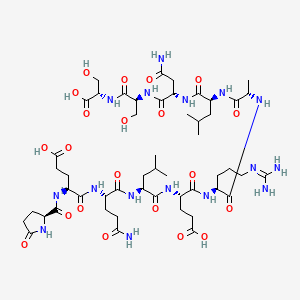
| CAS Number | 1208243-50-8 |
|---|---|
| Molecular Formula | C51H84N16O21 |
| Molecular Weight | 1257.3 g/Mol |
| Sequence | H-Pyr-Glu-Gln-Leu-Glu-Arg-Ala-Leu-Asn-Ser-Ser-OH |
Cosmic Peptides Certificate of Analysis
Unable to load certificate. Download COA