Bacteriostatic Water - 30ml, Glass
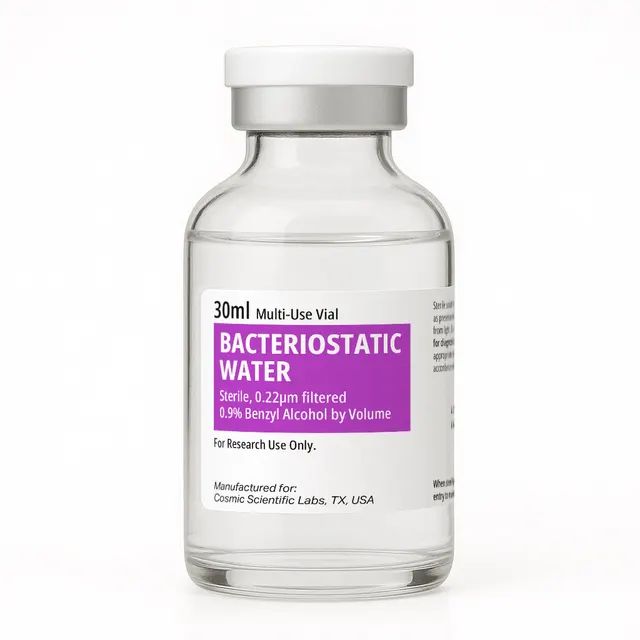
Bacteriostatic Water - 30ml, Glass
Commonly researched with these items
Patent-pending lot tracking: Complete transparency from production to vial.
| Lot Number | 26105 |
|---|
Bacteriostatic Water (30 mL, Glass): Purified Water with 0.9% Benzyl Alcohol as a Laboratory Diluent
Disclaimer
Products described here are supplied for research use only and are not intended for diagnostic, therapeutic, or clinical application. All statements regarding biological activity reflect preclinical and in vitro findings exclusively and have not been evaluated by the U.S. Food and Drug Administration. These materials and related content are provided for educational and investigational purposes only and are intended solely for qualified researchers in laboratory and academic settings.
Key Facts
- Compound class
- Aqueous research solvent: purified water containing benzyl alcohol as an antimicrobial (bacteriostatic) preservative
- Composition
- Water with 0.9% benzyl alcohol (9.0 mg/mL when expressed, as is conventional, weight per volume; 83.2 mmol/L)
- Sequence / structure
- Not applicable (a two-component solution). Preservative: benzyl alcohol, C6H5CH2OH (phenylmethanol)
- Molecular formula
- Water H2O; benzyl alcohol C7H8O
- Molecular weight
- Water 18.015 g/mol; benzyl alcohol 108.14 g/mol (monoisotopic mass 108.0575 Da)
- CAS number
- No single CAS number (mixture). Components: water 7732-18-5; benzyl alcohol 100-51-6
- PubChem CID
- Water 962; benzyl alcohol 244
- pH range
- 4.5–7.0 (unbuffered; the acidic end reflects dissolved atmospheric carbon dioxide)
- Container
- 30 mL sealed borosilicate glass vial
- Physical form as supplied
- Clear, colourless aqueous solution
- Lot traceability
- Every unit is tied to a tracked lot; the lot number, recorded purity and verified quantity of the lot on sale are shown live on this page, with its certificate of analysis.
Molecular Identity and Classification
Bacteriostatic water is not a single compound but a defined two-component solution: purified water as the solvent and benzyl alcohol as a dissolved antimicrobial preservative at a nominal 0.9%. By the usual convention for a dissolved solute this percentage is expressed weight per volume, so each millilitre carries 9.0 mg of benzyl alcohol. With a molecular weight of 108.14 g/mol, that is 83.2 mmol/L, or a mole fraction of about 1.5 × 10⁻³: for every benzyl alcohol molecule there are roughly 665 water molecules. A full 30 mL container therefore holds about 270 mg (2.50 mmol) of benzyl alcohol.
The solvent, water (H2O, 18.015 g/mol, CAS 7732-18-5, PubChem CID 962), makes up more than 99% of the mass. The preservative, benzyl alcohol (IUPAC name phenylmethanol, C7H8O, CAS 100-51-6, PubChem CID 244), is the simplest aromatic primary alcohol: a hydroxymethyl group (−CH2OH) attached to a benzene ring. Because the product is a mixture, it has no CAS number of its own, and the molecular-formula and molecular-weight fields that apply to a peptide describe here its two components separately.
The term bacteriostatic is precise. A bacteriostatic agent inhibits the growth and multiplication of bacteria without necessarily killing them in a short time; a bactericidal agent kills. At 0.9%, benzyl alcohol acts mainly in the first sense: it keeps a solution that is opened and sampled repeatedly from supporting microbial growth, rather than rendering contaminated material free of organisms. That distinction is why the product is classified as a preserved diluent rather than a disinfectant.
Benzyl alcohol has a long history as a molecule. Stanislao Cannizzaro first described it in 1853 as the alcohol corresponding to benzoic acid, obtained by reacting benzaldehyde with alcoholic potassium hydroxide. The disproportionation he observed, in which one aldehyde molecule is reduced to the alcohol while a second is oxidised to the carboxylate, is still taught as the Cannizzaro reaction, and it neatly frames the redox family to which the preservative belongs: benzyl alcohol, benzaldehyde and benzoic acid differ only in the oxidation state of a single benzylic carbon.
Structure and Chemical Features
The benzyl alcohol molecule has two parts with opposite characters. The phenyl ring is flat, non-polar and polarisable, and is responsible for the molecule's ultraviolet absorbance and its affinity for hydrophobic environments such as lipid bilayers and polymer surfaces. The hydroxymethyl group is small and polar: its hydroxyl acts as one hydrogen-bond donor and one acceptor (PubChem counts 1 and 1), and the topological polar surface area of the whole molecule is 20.2 Å2. This amphiphilic balance gives a measured octanol–water partition coefficient of log Kow 1.10: benzyl alcohol prefers octanol over water by roughly a factor of 12, yet it is soluble in water to about 42.9 g/L at 25 °C.
The hydroxyl is an ordinary aliphatic alcohol, not a phenol. The CH2 spacer isolates the oxygen from the aromatic ring, so the negative charge of the alkoxide cannot be delocalised into the ring and the O–H bond is only very weakly acidic (pKa about 15.4). The contrast with its structural isomer m-cresol (3-methylphenol, also C7H8O and 108.14 g/mol) is instructive: moving the oxygen directly onto the ring lowers the pKa to about 10.1. At any laboratory pH, benzyl alcohol is therefore entirely un-ionised, which is why it contributes no buffering capacity and no charge to the solution.
The benzylic carbon is the reactive site. C–H bonds adjacent to an aromatic ring are weaker than ordinary alkyl C–H bonds because the radical formed by removing the hydrogen is stabilised by the ring. Consequently, benzyl alcohol is slowly oxidised by atmospheric oxygen, first to benzaldehyde (C7H6O, 106.12 g/mol, CID 240) and then to benzoic acid (C7H6O2, 122.12 g/mol, CID 243). The process is slow at room temperature in a closed container but is accelerated by light, heat, a large headspace of air and trace metal ions. Benzaldehyde is the degradant that matters most for peptide work, because aldehydes condense reversibly with primary amines (N-terminal α-amines and lysine ε-amines) to form imines (Schiff bases).
Water as the Solvent
The water itself is chemically active in ways that shape the product. Purified water at equilibrium with air absorbs carbon dioxide, which hydrates to carbonic acid (pKa1 about 6.35). That single equilibrium explains why unbuffered laboratory water is mildly acidic and why the specified pH range of this product begins at 4.5. Because neither the water nor benzyl alcohol buffers the solution, the pH after a solute is dissolved is determined almost entirely by that solute and its counterions.
Synthesis and Manufacturing Chemistry
Each component has its own manufacturing chemistry. Benzyl alcohol is produced industrially mainly by hydrolysis of benzyl chloride (itself made by side-chain chlorination of toluene) with aqueous base such as sodium carbonate, and alternatively by catalytic hydrogenation of benzaldehyde. Grades intended for analytical and preservative use are purified by distillation (boiling point 205.3 °C at 760 mmHg) and specified for low levels of benzaldehyde, chlorinated by-products and peroxides, because these are the impurities that its chemistry predicts.
The water component is purified by some combination of distillation, reverse osmosis, ion exchange and filtration. The aim is to remove dissolved ions, organic matter, particulates and microorganisms. Ionic purity is usually tracked by conductivity: theoretically pure water has a conductivity of 0.055 µS/cm at 25 °C (resistivity 18.2 MΩ·cm), set only by its own autoionisation.
Preparation of the finished solution is gravimetric or volumetric. Benzyl alcohol is a liquid with a density of about 1.042 g/mL at 24 °C, so 9.0 mg per millilitre corresponds to about 8.6 µL per millilitre (0.86% v/v). This is the reason the specification is written weight per volume: a 0.9% v/v solution would contain about 9.4 mg/mL. The concentration is well below the solubility limit (it is about 21% of saturation at 25 °C and about 26% of saturation at 20 °C, where solubility falls to about 35 g/L), so the solution is a single stable phase with no tendency for the preservative to separate on cooling to refrigerator temperature. After mixing, the solution is typically passed through a 0.2 µm membrane filter, filled into cleaned glass containers and sealed with an elastomeric closure under an aluminium crimp.
Container and Closure Chemistry
This variant is packaged in borosilicate glass. Borosilicate glasses combine silica (SiO2, roughly 70–81%) with boron oxide (B2O3, roughly 7–13%) and smaller amounts of alkali oxides and alumina. Two families are common, named by their linear thermal expansion coefficient: expansion 3.3 (about 3.3 × 10⁻⁶ K−1, the highest-silica type) and expansion 5.1. Both have high hydrolytic resistance: very little sodium, borate or silica is extracted into water in contact with the surface. That resistance is not unconditional. In a designed experiment on glass vials, Iacocca and colleagues found that autoclave heating of the filled container, the glass composition and the solution chemistry were the key factors in generating glass flakes (delamination), whereas dry-heat processing of empty vials before filling played no significant role, and they proposed dissolved silica as an early indicator of attack. Guadagnino and Zuccato ran repeated 121 °C extractions with different media and showed that alkaline solutions, and organic acids such as citric and glutaric acid, raise silica extraction; under alkaline conditions expansion-3.3 glass corroded most heavily of the types tested, and delamination concentrated at the base and shoulder, where flame forming of tubing depletes alkali and borate and leaves a silica-rich surface layer. An unbuffered, slightly acidic solution of water and a neutral, non-chelating alcohol stored at room temperature sits at the benign end of each of these factors. Dissolved silica, measured by ICP-OES or a molybdate colorimetric assay, is the analytical check if container attack is ever suspected.
The glass itself takes up essentially no benzyl alcohol. Elastomeric closures and polymer containers are different: they are organic phases into which a solute with log Kow 1.1 can partition to a small extent. This is the main chemical argument for glass when preservative concentration must stay constant over the life of the container, and it is the key difference from the 30 mL HDPE bacteriostatic water, which offers break resistance in exchange for a polymer contact surface.
Analytical Characterization
Characterising bacteriostatic water means answering four questions: is the preservative present at the right concentration, has it degraded, is the water of the right quality, and is the pH within range.
Benzyl alcohol assay. Reversed-phase HPLC with UV detection is the standard approach. On a C18 column with a water–methanol or water–acetonitrile mobile phase, benzyl alcohol elutes early relative to more lipophilic aromatics, and benzaldehyde and benzoic acid are resolved from it (benzoic acid retention depends strongly on mobile-phase pH, since its carboxylic acid has a pKa near 4.2). The aromatic ring gives absorption bands at 243, 258.5 and 268 nm, with log ε = 2.26 at the 258.5 nm maximum (ε ≈ 182 L·mol−1·cm−1). Gas chromatography with flame-ionisation detection is a common orthogonal method because benzyl alcohol is volatile enough to chromatograph directly from aqueous solution.
Mass spectrometry. Benzyl alcohol is a neutral, weakly basic molecule and ionises poorly by electrospray. In positive mode it appears mainly as the sodium adduct [M+Na]+ at m/z 131.0467 and as the in-source dehydration product C7H7+ (benzyl or tropylium cation) at m/z 91.0542; the protonated molecule [M+H]+ at m/z 109.0648 is usually weak. Under electron ionisation in GC-MS, the base peak is m/z 79 (loss of CHO from the molecular ion, giving C6H7+), followed by the molecular ion at m/z 108 (about 83% relative intensity), m/z 107 (about 62%) and the phenyl cation at m/z 77 (about 54%), the pattern recorded in the reference EI spectra in PubChem. For degradants, benzaldehyde gives [M+H]+ at m/z 107.0491 and benzoic acid ionises well in negative mode as [M−H]− at m/z 121.0295.
Water quality and pH. pH is measured potentiometrically. Because the solution has almost no ionic strength, readings drift on ordinary electrodes; a low-ionic-strength electrode or a small addition of neutral salt to a separate aliquot gives stable values. Conductivity is a useful check on ionic contamination, since benzyl alcohol, being un-ionised, contributes almost nothing to it. Total organic carbon (TOC), on the other hand, is not a meaningful water-purity measure for this product: the worked calculation below shows why.
| Quantity | Calculation | Result |
|---|---|---|
| Molar concentration | 9.0 g/L ÷ 108.14 g/mol | 83.2 mmol/L |
| Benzyl alcohol per 30 mL | 9.0 mg/mL × 30 mL | 270 mg (2.50 mmol) |
| Volume fraction | 9.0 mg/mL ÷ 1.042 mg/µL | 8.6 µL/mL (0.86% v/v) |
| Fraction of saturation at 25 °C | 9.0 g/L ÷ 42.9 g/L | 21% |
| Carbon contributed (TOC) | 9.0 mg/mL × (7 × 12.011 ÷ 108.14) | 7.0 mg C/mL (7,000 mg/L) |
| Absorbance at 258.5 nm, 1 cm path | 182 L·mol−1·cm−1 × 0.0832 mol/L | about 15 (far off scale) |
| Ideal osmolarity | non-electrolyte, 1 particle per molecule | about 83 mOsm/L |
| Freezing-point lowering | 1.86 K·kg/mol × 0.084 mol/kg | about 0.16 K |
| pH of CO2-equilibrated water | [H+] = √(Ka1 × KH × pCO2), with KH 0.034 mol/(L·atm), pCO2 4.2 × 10⁻⁴ atm | about pH 5.6 |
| Conductivity from dissolved CO2 | 2.5 µmol/L each of H+ and HCO3− × (349.8 + 44.5) S·cm2/mol | about 1.0 µS/cm |
Two of these numbers have direct consequences. The organic-carbon load of 7,000 mg/L is many orders of magnitude above the sub-mg/L TOC limits used for purified water, so any TOC result for this product simply measures the preservative. And the 258 nm absorbance of about 15 means that undiluted bacteriostatic water is opaque to a spectrophotometer in the near-UV; even a 1:100 dilution still absorbs about 0.15 at the band maximum.
Physicochemical Properties
| Property | Value | Notes |
|---|---|---|
| Molecular formula (benzyl alcohol) | C7H8O | Phenylmethanol, CAS 100-51-6 |
| Molecular weight | 108.14 g/mol | Monoisotopic mass 108.0575 Da |
| Density (neat) | 1.0419 g/cm3 at 24 °C | Slightly denser than water |
| Boiling point / melting point | 205.3 °C / −15.2 °C | At 760 mmHg |
| Water solubility | 42.9 g/L at 25 °C; 35 g/L at 20 °C | The 9.0 g/L in this product is well below saturation |
| log Kow | 1.10 | Moderately lipophilic; partitions into membranes and polymers |
| pKa (O–H) | 15.4 | Un-ionised at all laboratory pH values |
| Vapour pressure | 0.094 mmHg at 25 °C | Low volatility; evaporative loss from a closed container is negligible |
| Henry's law constant | 3.37 × 10⁻⁷ atm·m3/mol at 25 °C | Strongly retained in the aqueous phase |
| Refractive index (neat) | 1.5396 at 20 °C (sodium D line) | Identity check for the raw material |
| Viscosity (neat) | 5.474 cP at 25 °C | The 0.9% solution is essentially as fluid as water |
| UV absorption maxima | 243, 258.5, 268 nm (log ε 1.91, 2.26, 1.95) | Measured in ethanol |
| Odour threshold | about 5.5 ppm (in air) | Faint aromatic odour; benzaldehyde adds a bitter-almond note |
| Solution pH | 4.5–7.0 | Unbuffered |
| Solution osmolarity (ideal) | about 83 mOsm/L | Strongly hypotonic relative to about 290 mOsm/kg culture media |
Taken together, the properties describe a preservative that stays where it is put. Its low vapour pressure and small Henry's law constant mean it does not evaporate from the solution at any meaningful rate, and its solubility margin means it cannot phase-separate. The properties that make it chemically interesting, a log Kow above 1 and a reactive benzylic carbon, are the ones that require attention: partitioning into hydrophobic phases (membranes, plastics, rubber, protein surfaces) and slow oxidation to benzaldehyde.
Research Context
In a research laboratory, bacteriostatic water serves as a preserved aqueous diluent: a vehicle for dissolving lyophilised peptides and other water-soluble research compounds when a stock solution will be sampled more than once over a period of days. The preservative limits microbial growth introduced by repeated opening, which would otherwise degrade peptides enzymatically and introduce particulates and microbial by-products into in vitro experiments.
The mechanism of benzyl alcohol's antimicrobial action is shared with other membrane-active alcohols and aromatic preservatives. As McDonnell and Russell describe in their review of biocide action, such agents partition into the cytoplasmic membrane of microorganisms, disorganise the lipid packing and increase permeability, leading to leakage of intracellular constituents and loss of the proton-motive force on which growth depends. At preservative concentrations the effect is growth-inhibitory rather than rapidly lethal, and bacterial spores are largely unaffected.
The same physical chemistry makes benzyl alcohol an established research tool in membrane biophysics. Ebihara and colleagues used optical, electrical and X-ray diffraction measurements to show that the answer to a simple question, does benzyl alcohol thicken or thin a bilayer, depends on the model: it thickened planar bilayers containing n-alkane solvent, thinned "solvent-free" planar bilayers and solvent-free gel-phase vesicles, and had no measurable effect on vesicle bilayer thickness above the phase transition. Chabanel and colleagues separated the two leaflets of the isolated red-cell membrane with permeant and impermeant fluorescent probes: up to 50 mM, benzyl alcohol produced stomatocytic shape change and fluidised mainly the inner leaflet; above 50–60 mM, cells became echinocytic and both leaflets were fluidised, with no change in membrane viscoelasticity measured by micropipette aspiration. Balogh and co-workers used benzyl alcohol and heptanol as two structurally distinct "membrane fluidisers", each at the concentration that gave identical fluidity increases in K562 cells by DPH anisotropy, and found that this isofluid state, at constant temperature, lowered the temperature threshold of the heat shock response and raised HSP70 gene expression, without evidence of a protein-unfolding signal. The concentrations in these in vitro studies, tens of millimolar, overlap the 83 mM present in undiluted bacteriostatic water.
Interactions with Proteins and Peptides
A second body of in vitro work concerns benzyl alcohol and protein conformational stability. Zhang and colleagues showed that benzyl alcohol accelerates the aggregation and precipitation of recombinant interleukin-1 receptor antagonist at 37 °C, followed as loss of native monomer by size-exclusion HPLC. The preservative caused a minor perturbation of tertiary structure with no change in secondary structure, faster hydrogen–deuterium exchange and increased ANS fluorescence, yet it did not change the free energy of unfolding measured in urea or guanidine hydrochloride. Isothermal titration calorimetry showed a weak, hydrophobically driven interaction, and sucrose, which is preferentially excluded from the protein surface, partially inhibited the effect. The mechanism they proposed is a small shift of the conformational population towards partially unfolded, aggregation-competent species. Roy and colleagues extended this to the temperature dependence of benzyl alcohol- and ANS-induced aggregation of the same protein. Tobler and colleagues, using hydrogen exchange detected by mass spectrometry on interferon-γ, found that the tertiary change involved only a limited part of the protein while the hydrophobic core stayed intact, that unfolding rates were very sensitive to benzyl alcohol concentration and rose markedly when salt was also present, and that over 8 days a significant fraction became trapped in a less protected but not fully unfolded state. The common conclusion is that a weakly hydrophobic small molecule can shift a folded protein towards aggregation-prone states without unfolding it, and that ionic strength can amplify the effect.
For short peptides that have no stable tertiary structure, such as KPV or BPC-157, there is no folded state to destabilise, and benzyl alcohol mainly acts as a mild co-solvent. The more relevant chemical considerations for peptides are the benzaldehyde content of an aged solution (imine formation with free amines) and the unbuffered pH, which is set by the peptide's own counterions. A simple molar comparison shows how much preservative accompanies a typical peptide stock: 5 mg of a 342 g/mol tripeptide dissolved in 2 mL is 14.6 µmol of peptide alongside 166 µmol of benzyl alcohol, an excess of about eleven-fold. For a research design, that ratio is the reason to include benzyl alcohol at the same final concentration in vehicle controls.
| Dilution of stock | Benzyl alcohol, % (w/v) | Benzyl alcohol, molar | Context |
|---|---|---|---|
| Undiluted | 0.9% | 83 mM | Range of membrane-fluidisation and aggregation studies |
| 1:10 | 0.09% | 8.3 mM | Matched vehicle control recommended |
| 1:100 | 0.009% | 0.83 mM | Matched vehicle control still advisable in sensitive cell assays |
| 1:1,000 | 0.0009% | 83 µM | Typically far below membrane-active levels |
| 1:10,000 | 0.00009% | 8.3 µM | Effectively negligible for most read-outs |
Comparison with Related Diluents and Preservatives
Choosing a diluent is a chemistry decision. The table compares this product with the other aqueous solvents in the range and with plain water.
| Diluent | Solutes | Approximate osmolarity | Container contact surface | Best suited to |
|---|---|---|---|---|
| Bacteriostatic water, 30 mL glass (this product) | Benzyl alcohol 9.0 mg/mL | 83 mOsm/L | Borosilicate glass | Stocks sampled repeatedly where constant preservative level and inert contact surface matter |
| Bacteriostatic water, 30 mL HDPE | Benzyl alcohol 9.0 mg/mL | 83 mOsm/L | High-density polyethylene | The same solution where break resistance is a priority |
| Bacteriostatic water, 10 mL | Benzyl alcohol 9.0 mg/mL | 83 mOsm/L | Borosilicate glass | Smaller working volumes, less headspace turnover per container |
| Bacteriostatic saline, 30 mL | Benzyl alcohol 9.0 mg/mL plus sodium chloride 9.0 mg/mL (154 mM) | about 390 mOsm/L (ideal) | Glass | Work requiring ionic strength; note chloride and salting-out effects on some peptides |
| Unpreserved purified water | None | about 0 | Varies | Single-use solutions, UV spectroscopy, MS-clean stocks |
Benzyl alcohol is one of a small family of aromatic and halogenated alcohols used to preserve aqueous solutions. Its closest chemical relatives are phenol (C6H6O, 94.11 g/mol, CID 996, pKa 9.99, XLogP 1.5), its isomer m-cresol (C7H8O, 108.14 g/mol, CID 342, pKa 10.1, XLogP 2.0), chlorobutanol (C4H7Cl3O, 177.45 g/mol, CID 5977) and phenoxyethanol (C8H10O2, 138.16 g/mol, CID 31236). The phenols are partly ionised in alkaline buffers and are more reactive towards oxidants; chlorobutanol is volatile and slowly hydrolyses. Benzyl alcohol's advantages are its complete non-ionisation, high water solubility and low volatility; its disadvantage is the slow oxidation of the benzylic carbon.
Laboratory Handling and Storage
Storage of the sealed container. Store upright at controlled room temperature (20–25 °C), protected from light, and avoid freezing. Light and heat accelerate the autoxidation of benzyl alcohol, and freezing in glass risks fracture as water expands by about 9% on crystallisation. Refrigeration is acceptable: the preservative remains far below its solubility limit at 2–8 °C.
After opening. Keep the closure intact and the container closed between uses, and work with aseptic technique in a clean environment, because the preservative inhibits growth but cannot compensate for gross contamination. A faint aromatic odour is normal; a distinct bitter-almond odour, a yellow tint, visible particles or cloudiness indicate benzaldehyde formation or contamination, and the solution should be discarded. Each opening exchanges headspace air and introduces fresh oxygen, so a container used daily ages faster than one opened rarely; a smaller container such as the 10 mL format limits this.
Preparing peptide stock solutions. Allow lyophilised material to reach room temperature before opening, add the diluent gently down the inner wall of the peptide vial and swirl rather than shake, to limit foaming and air–water interface effects. Because the diluent is unbuffered, the resulting pH depends on the peptide and its counterions (trifluoroacetate or acetate); if a defined pH matters, dissolve in buffer instead or measure the pH of a small aliquot. Peptides that are poorly soluble near neutral pH may need a small amount of dilute acetic acid or another co-solvent first.
Compatibility with downstream analysis. For UV spectroscopy (A280 concentration estimates, A260 nucleic-acid measurement, far-UV circular dichroism) benzyl alcohol absorbs strongly enough to interfere; use unpreserved water or buffer, or prepare an exactly matched blank and confirm linearity. For LC-MS, benzyl alcohol appears as a sharp early peak and as m/z 91 and 131 ions; it is easily distinguished but should be expected in the chromatogram. For cell-based assays, dilute the stock enough that the final benzyl alcohol concentration is low (see the dilution table) and include the same concentration in vehicle controls.
Frequently Asked Research Questions
- What is bacteriostatic water, chemically?
- It is purified water containing 0.9% (w/v) benzyl alcohol, C7H8O, as an antimicrobial preservative. Each millilitre contains 9.0 mg of benzyl alcohol, a molar concentration of 83.2 mmol/L.
- What does "bacteriostatic" mean here?
- A bacteriostatic agent inhibits bacterial growth and multiplication rather than rapidly killing bacteria. At 0.9%, benzyl alcohol keeps a solution that is opened repeatedly from supporting microbial growth; it does not decontaminate material that is already heavily contaminated, and it has little effect on bacterial spores.
- How does benzyl alcohol inhibit microbial growth?
- Benzyl alcohol is amphiphilic (log Kow 1.10). It partitions into microbial cytoplasmic membranes, perturbs the lipid packing and increases permeability, which dissipates the membrane potential and causes leakage of cell contents.
- Why is the pH between 4.5 and 7.0 and not exactly 7?
- The solution is unbuffered. Water in contact with air dissolves carbon dioxide, forming carbonic acid; at today's atmospheric CO2 level the equilibrium pH of pure water is about 5.6. Benzyl alcohol (pKa 15.4) is not ionised and does not change the pH.
- Will benzyl alcohol interfere with UV absorbance measurements?
- Yes. Benzyl alcohol absorbs at 243, 258.5 and 268 nm, with a molar absorptivity of about 182 L·mol−1·cm−1 at 258.5 nm. At 83 mM the absorbance at 258.5 nm in a 1 cm cell is about 15. Use unpreserved water or buffer for UV quantification, or a precisely matched blank.
- What does benzyl alcohol look like in LC-MS?
- It ionises poorly by electrospray. Expect the sodium adduct [M+Na]+ at m/z 131.0467 and the C7H7+ ion at m/z 91.0542; the protonated molecule at m/z 109.0648 is usually weak. Its oxidation products benzaldehyde ([M+H]+ 107.0491) and benzoic acid ([M−H]− 121.0295) indicate an aged solution.
- Can benzyl alcohol affect proteins or peptides in solution?
- For folded proteins, yes: in vitro studies on interleukin-1 receptor antagonist and interferon-γ showed that benzyl alcohol binds weakly through hydrophobic contacts, shifts the population towards partially unfolded, aggregation-competent states and accelerates aggregation, an effect that added salt amplified for interferon-γ. Short, unstructured peptides have no fold to destabilise; for them the main considerations are benzaldehyde in aged solutions, which can form imines with free amines, and the unbuffered pH.
- How much benzyl alcohol ends up in a cell-based assay?
- It depends on the dilution of the stock: 1:10 gives 8.3 mM, 1:100 gives 0.83 mM and 1:1,000 gives 83 µM. In vitro membrane studies report shape and fluidity changes in isolated red cells up to 50 mM and both-leaflet fluidisation above 50–60 mM, so diluting at least 1:1,000 and including a matched vehicle control is good practice.
- Why choose glass over HDPE for bacteriostatic water?
- Borosilicate glass is chemically inert towards benzyl alcohol and has high hydrolytic resistance, so the preservative concentration and the solution's composition stay constant. Polymer surfaces are an organic phase into which a moderately lipophilic solute can partition slightly, but they are break-resistant.
- How is bacteriostatic water different from bacteriostatic saline?
- Both contain 0.9% benzyl alcohol. Bacteriostatic saline also contains 0.9% sodium chloride (154 mM), giving an ionic solution with an ideal osmolarity of about 390 mOsm/L, whereas bacteriostatic water has almost no ionic strength and an osmolarity of about 83 mOsm/L.
- How can I tell whether an opened container has degraded?
- Look for a yellow tint, particles or cloudiness, and note any bitter-almond odour, which indicates benzaldehyde from oxidation of benzyl alcohol. HPLC-UV or GC can quantify benzyl alcohol and benzaldehyde directly.
- Where can I see the quality data for the bacteriostatic water I am buying?
- This page shows the lot number and verified data of the lot currently on sale, taken live from the shop's lot-tracking database, together with that lot's certificate of analysis.
Sources & Further Reading
- National Center for Biotechnology Information. PubChem Compound Summary for CID 244, Benzyl Alcohol. PubChem CID 244.
- National Center for Biotechnology Information. PubChem Compound Summary for CID 962, Water. PubChem CID 962.
- National Center for Biotechnology Information. PubChem Compound Summary for CID 240, Benzaldehyde. PubChem CID 240.
- Cannizzaro S. Ueber den der Benzoësäure entsprechenden Alkohol. Justus Liebigs Annalen der Chemie 1853;88(1):129–130. doi:10.1002/jlac.18530880114
- McDonnell G, Russell AD. Antiseptics and disinfectants: activity, action, and resistance. Clinical Microbiology Reviews 1999;12(1):147–179. doi:10.1128/CMR.12.1.147
- Ebihara L, Hall JE, MacDonald RC, McIntosh TJ, Simon SA. Effect of benzyl alcohol on lipid bilayers. A comparisons of bilayer systems. Biophysical Journal 1979;28(2):185–196. doi:10.1016/S0006-3495(79)85170-X
- Chabanel A, Abbott RE, Chien S, Schachter D. Effects of benzyl alcohol on erythrocyte shape, membrane hemileaflet fluidity and membrane viscoelasticity. Biochimica et Biophysica Acta (BBA) - Biomembranes 1985;816(1):142–152. doi:10.1016/0005-2736(85)90402-X
- Balogh G, Horváth I, Nagy E, et al. The hyperfluidization of mammalian cell membranes acts as a signal to initiate the heat shock protein response. The FEBS Journal 2005;272(23):6077–6086. doi:10.1111/j.1742-4658.2005.04999.x
- Zhang Y, Roy S, Jones LS, et al. Mechanism for benzyl alcohol-induced aggregation of recombinant human interleukin-1 receptor antagonist in aqueous solution. Journal of Pharmaceutical Sciences 2004;93(12):3076–3089. doi:10.1002/jps.20219
- Roy S, Katayama D, Dong A, Kerwin BA, Randolph TW, Carpenter JF. Temperature dependence of benzyl alcohol- and 8-anilinonaphthalene-1-sulfonate-induced aggregation of recombinant human interleukin-1 receptor antagonist. Biochemistry 2006;45(12):3898–3911. doi:10.1021/bi052132g
- Tobler SA, Holmes BW, Cromwell MEM, Fernandez EJ. Benzyl alcohol-induced destabilization of interferon-γ: a study by hydrogen-deuterium isotope exchange. Journal of Pharmaceutical Sciences 2004;93(6):1605–1617. doi:10.1002/jps.10589
- Light TS, Licht S, Bevilacqua AC, Morash KR. The fundamental conductivity and resistivity of water. Electrochemical and Solid-State Letters 2005;8(1):E16. doi:10.1149/1.1836121
- Iacocca RG, Toltl N, Allgeier M, et al. Factors affecting the chemical durability of glass used in the pharmaceutical industry. AAPS PharmSciTech 2010;11(3):1340–1349. doi:10.1208/s12249-010-9506-9
- Guadagnino E, Zuccato D. Delamination propensity of pharmaceutical glass containers by accelerated testing with different extraction media. PDA Journal of Pharmaceutical Science and Technology 2012;66(2):116–125. doi:10.5731/pdajpst.2012.00853
Last reviewed:
In the research library
The methods behind the numbers on a certificate of analysis.
- How to read a certificate of analysis What a peptide certificate of analysis should contain, how to check that it belongs to the material in hand, how to read its identity and purity results, and the signs that it deserves a second look.
- Bacteriostatic water and bacteriostatic saline as laboratory reagents What the two preserved aqueous reagents contain, in every unit, what 0.9% benzyl alcohol does to microbes and to peptides, and the spectroscopy, chromatography and cell-based work where plain water is the better solvent.
- Preparing peptide solutions in the laboratory From a freeze-dried vial to a solution of known concentration: the arithmetic, the solvent, the charge chemistry and the handling, with the errors each step can introduce and the article that covers it.
- Peptide stability and storage How peptides degrade, chemically and physically, why the dry solid lasts far longer than a solution, which sequences are most at risk, and the storage and handling that slow it down.
- Water content of peptides: Karl Fischer titration How Karl Fischer titration measures the water in a freeze-dried peptide, why the coulometric and oven methods suit peptide samples, what interferes, and how the result is used.