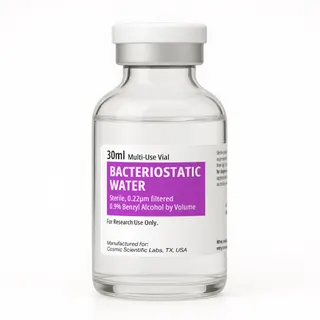
Bacteriostatic Water - 10ml
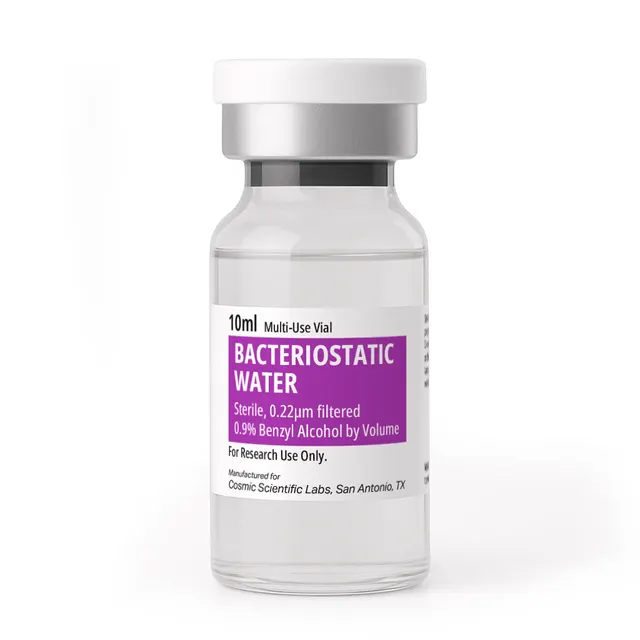
Bacteriostatic Water - 10ml
Commonly researched with these items
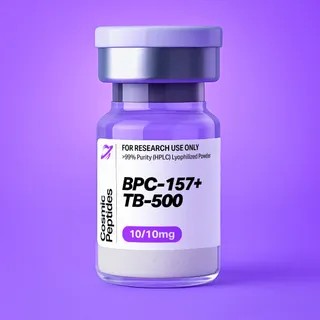
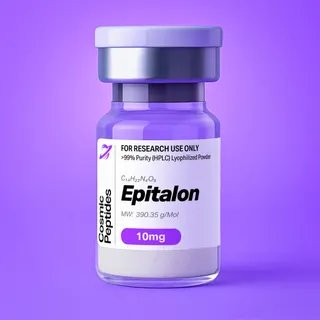
Patent-pending lot tracking: Complete transparency from production to vial.
Bacteriostatic Water (10 mL): Aqueous Laboratory Diluent Preserved with 0.9% Benzyl Alcohol
Disclaimer
Products described here are supplied for research use only and are not intended for diagnostic, therapeutic, or clinical application. All statements regarding biological activity reflect preclinical and in vitro findings exclusively and have not been evaluated by the U.S. Food and Drug Administration. These materials and related content are provided for educational and investigational purposes only and are intended solely for qualified researchers in laboratory and academic settings.
Key Facts
- Compound class
- Research solvent: a two-component aqueous solution of high-purity water containing benzyl alcohol as an antimicrobial preservative
- Sequence / structure
- Not a peptide. Components: water (H2O) and benzyl alcohol (phenylmethanol, C6H5CH2OH)
- Molecular formula
- A mixture has no single formula. Water H2O; benzyl alcohol C7H8O
- Molecular weight
- Water 18.015 g/mol; benzyl alcohol 108.14 g/mol (monoisotopic mass 108.0575 Da)
- CAS number
- None for the mixture. Components: water 7732-18-5; benzyl alcohol 100-51-6
- PubChem CID
- Water 962; benzyl alcohol 244
- Composition
- Benzyl alcohol 0.9% (w/v), that is 9 mg/mL or about 83.2 mmol/L, in water; no buffer and no added salt
- Volume
- 10 mL per vial, which contains about 90 mg (0.83 mmol) of benzyl alcohol
- Physical form as supplied
- Clear, colourless aqueous solution in a sealed borosilicate glass vial
- Lot traceability
- Every unit is tied to a tracked lot; the lot number, recorded purity and verified quantity of the lot on sale are shown live on this page, with its certificate of analysis.
Molecular Identity and Classification
Bacteriostatic water is not a single compound but a defined solution: high-purity water in which benzyl alcohol is dissolved at 0.9% weight per volume. The two components are water (CAS 7732-18-5, PubChem CID 962, IUPAC name oxidane) and benzyl alcohol (CAS 100-51-6, PubChem CID 244, IUPAC name phenylmethanol). Because it is a mixture, it has no CAS number, molecular formula or molecular weight of its own; any of those values printed for "bacteriostatic water" as if it were a pure substance actually describe one of its components.
The name describes function. A bacteriostatic agent inhibits the multiplication of bacteria without necessarily killing them, in contrast to a bactericidal agent, which reduces the number of viable cells. Membrane-active preservatives such as aromatic alcohols tend to be bacteriostatic at low concentrations and become bactericidal only at considerably higher ones, a concentration dependence reviewed in detail by McDonnell and Russell. At 0.9%, benzyl alcohol is chosen to hold microbial growth in check in a container that is opened and sampled more than once, while remaining dilute enough to be compatible with most dissolved solutes.
In the laboratory this solution is classed as a research solvent or preserved aqueous diluent. It belongs to the same family as plain high-purity water (unpreserved, single-use once opened) and preserved saline (the same preservative in 0.9% sodium chloride). Its defining features are its very low ionic strength, the absence of a buffer, and the presence of one small, neutral, mildly hydrophobic organic solute at a known concentration. Each of those features has practical consequences for the solutes a researcher dissolves in it, and they are the subject of the sections that follow.
Structure and Chemical Features
Benzyl alcohol is the simplest aromatic primary alcohol: a phenyl ring joined to a hydroxymethyl group (C6H5–CH2–OH, SMILES C1=CC=C(C=C1)CO, InChIKey WVDDGKGOMKODPV-UHFFFAOYSA-N). It has one hydrogen-bond donor, one hydrogen-bond acceptor, one rotatable bond and a topological polar surface area of 20.2 Å2. The molecule is amphiphilic in miniature: the hydroxyl group hydrogen-bonds to water, while the flat, polarizable phenyl ring is hydrophobic. That balance gives it an octanol–water partition coefficient (log Kow) of 1.10, high enough to partition into lipid bilayers and hydrophobic pockets of proteins, and low enough to dissolve in water to about 42.9 mg/mL at 25 °C.
Three structural points explain most of its behaviour in solution. First, the hydroxyl group is a very weak acid (pKa about 15.4), so benzyl alcohol is uncharged across the entire aqueous pH range and contributes no buffering capacity. Second, the CH2 group sits at the benzylic position, where the adjacent aromatic ring stabilizes radicals and carbocations; this is why benzyl alcohol oxidizes slowly in air, first to benzaldehyde and then to benzoic acid, and why under strongly acidic conditions or in the mass spectrometer it readily loses water to form the resonance-stabilized C7H7+ cation. Third, the phenyl ring is a chromophore, so benzyl alcohol absorbs ultraviolet light, which matters for any UV-based measurement made on a solute dissolved in this solvent.
Water, the bulk component, accounts for more than 99% of the solution by mass. At 83.2 mmol/L benzyl alcohol against roughly 55.3 mol/L water, the mole fraction of benzyl alcohol is only about 0.0015: on average, one benzyl alcohol molecule for every 665 water molecules. The solution is therefore thermodynamically dilute and behaves, for most purposes, like water with a dissolved neutral co-solute. Around each benzyl alcohol molecule the water forms a hydrophobic hydration shell, and it is the energetic cost of that shell that drives benzyl alcohol to associate with hydrophobic surfaces such as membranes, plastics and exposed protein side chains.
Synthesis and Manufacturing Chemistry
Benzyl alcohol is manufactured industrially mainly by hydrolysis of benzyl chloride, itself made by side-chain chlorination of toluene, and also by catalytic hydrogenation of benzaldehyde. The routes matter to the analyst because they define the expected trace impurities: benzaldehyde (from incomplete reduction or from later air oxidation), benzoic acid (the further oxidation product), dibenzyl ether (from acid-catalysed self-condensation) and, depending on the route, traces of chlorinated aromatics. Grades of benzyl alcohol intended for preservative use are specified with limits on these related substances and on peroxides, because benzaldehyde in particular is chemically reactive towards amines.
Water for a laboratory diluent is typically produced by a sequence of purification steps: reverse osmosis or distillation to remove dissolved salts and organic matter, ion exchange to lower conductivity further, and filtration. Distillation has the added advantage of removing non-volatile organic and particulate material together with ions. The quality of the finished water is described by its conductivity, total organic carbon (TOC) and microbial content.
The finished solution is prepared by dissolving benzyl alcohol to 9 g per litre (in practice about 8.6 mL of the liquid, since its density is 1.04 g/mL), mixing until homogeneous, filtering through a 0.2 µm membrane and filling into containers that are then closed with an elastomeric stopper and an aluminium crimp seal. Glass is the usual primary container because benzyl alcohol, as a mildly lipophilic organic solute, can partition into some polymers. Type I borosilicate glass has low alkali content and high chemical durability, so it releases very little sodium, borate or silica into an unbuffered solution; Iacocca and colleagues showed that glass chemistry, solution chemistry and autoclaving of the filled container are the main factors governing glass surface attack and flake formation in vials, which is why the combination of borosilicate glass and a near-neutral, low-ionic-strength solution is chemically favourable.
Analytical Characterization
A preserved diluent is characterized by a short list of attributes: the identity and concentration of the preservative, its degradation products, the pH and conductivity of the solution, and its particulate and microbiological quality. Each lot's certificate of analysis, linked on this page, records the results that apply to that lot.
Assay of Benzyl Alcohol and Its Oxidation Products
Benzyl alcohol content is measured by reversed-phase HPLC with UV detection or by gas chromatography with flame ionization detection. On a C18 column with a water–acetonitrile or water–methanol mobile phase, benzyl alcohol, benzaldehyde and benzoic acid are well resolved; benzoic acid (pKa 4.2) is retained more strongly when the mobile phase is acidified, because its neutral form is more hydrophobic. Detection around 254–258 nm suits benzyl alcohol, whose weak aromatic absorption band has its maximum at 258.5 nm (log ε 2.26, about 180 L mol−1 cm−1, measured in ethanol). Benzaldehyde has a far stronger absorption from its conjugated carbonyl group, so even small amounts are easy to detect, which makes the benzaldehyde peak a sensitive indicator of oxidative degradation of the solution.
Two worked numbers show how strongly the preservative dominates any UV measurement. At 83.2 mmol/L and ε258 ≈ 182 L mol−1 cm−1, undiluted bacteriostatic water has a calculated absorbance at 258 nm of about 15 in a 1 cm cell, far beyond the linear range of a spectrophotometer. Even after a 1:100 dilution the benzyl alcohol absorbance at 258 nm is about 0.15. Any UV quantification of a solute dissolved in this solvent must therefore use the same solvent, at the same dilution, as the blank.
NMR gives an orthogonal, standard-free check. In D2O, benzyl alcohol shows its benzylic CH2 as a two-proton singlet near δ 4.63 ppm and its five aromatic protons as a multiplet at δ 7.36–7.45 ppm; in the 13C spectrum the CH2 carbon appears near δ 66.6 ppm and the ring carbons between δ 130 and 143 ppm (PubChem reference spectra). The CH2 singlet lies close to the residual HDO signal (about δ 4.79 ppm at 25 °C), so quantitative work usually integrates the aromatic multiplet against a weighed internal standard with a well-separated singlet, such as maleic acid near δ 6.3 ppm. Benzaldehyde, if present, is revealed by its aldehyde proton near δ 10 ppm, a region otherwise almost empty. The same signals appear in the NMR spectrum of any peptide dissolved in this solvent, where the aromatic multiplet can overlap phenylalanine, tyrosine and tryptophan resonances: an NMR study of a solute is best run on material dissolved in unpreserved water or D2O.
Mass Spectrometry
Benzyl alcohol has a monoisotopic mass of 108.0575 Da. In electron-ionization GC-MS it gives an intense molecular ion at m/z 108 and a base peak at m/z 79, the C6H7+ ion left after loss of a formyl unit (29 Da); further fragments appear at m/z 107 ([M−H]+), 91, 77 (C6H5+) and 51, the pattern recorded in the PubChem reference spectra. In positive electrospray it ionizes poorly as [M+H]+ (m/z 109.0648); more often it is seen as the sodium adduct [M+Na]+ at m/z 131.0467 or, after in-source loss of water, as the C7H7+ ion at m/z 91.0542. When a peptide dissolved in this solvent is analysed by LC-MS, benzyl alcohol elutes as its own peak, usually well separated from polar peptides, and can be diverted to waste.
A more subtle analytical signature concerns the oxidation product benzaldehyde. Aldehydes condense reversibly with primary amines, such as a peptide N-terminus or a lysine side chain, to form imines (Schiff bases). Such an adduct adds C7H4 to the peptide, a mass shift of +88.0313 Da; if the imine is reduced, the resulting N-benzyl derivative appears at +90.0470 Da. A peak at M+88 in the mass spectrum of an amine-containing solute stored in an old, partly oxidized benzyl alcohol solution is therefore worth investigating before it is assigned to a synthesis impurity.
pH, Conductivity and Particulates
The pH specification for this class of solution is typically 4.5 to 7.0, a wide range that reflects chemistry rather than imprecision. Unbuffered, low-ionic-strength water equilibrates with atmospheric carbon dioxide: with a CO2 partial pressure of about 420 ppm, a Henry's-law constant of 0.034 mol L−1 atm−1 and a first carbonic-acid pKa of 6.35, the calculated equilibrium pH is about 5.6. Measuring the pH of such a solution reliably requires an electrode designed for low-ionic-strength samples, or the addition of a small, known amount of potassium chloride to the measured aliquot, because ordinary electrodes drift in nearly salt-free water. Conductivity, a direct measure of ionic content, is low, and visible particulate matter is assessed by inspection against black and white backgrounds.
Physicochemical Properties
| Property | Value | Notes |
|---|---|---|
| Benzyl alcohol concentration | 0.9% (w/v) = 9 mg/mL = 83.2 mmol/L | Calculated from 108.14 g/mol |
| Benzyl alcohol per 10 mL vial | 90 mg = 0.832 mmol (about 86 µL of liquid) | Calculated; density 1.042 g/mL at 24 °C |
| Volume fraction of benzyl alcohol | about 0.86% (v/v) | Calculated |
| Mole fraction of benzyl alcohol | about 0.0015 | Calculated against 55.3 mol/L water |
| Fraction of saturation at 25 °C | about 21% | Aqueous solubility 42.9 mg/mL at 25 °C |
| pH | typically 4.5–7.0 | Unbuffered; about 5.6 at equilibrium with air (calculated) |
| Buffer capacity / ionic strength | essentially none / near zero | No salts or buffer added |
| Osmolality contribution of benzyl alcohol | about 84 mOsm/kg | Calculated for an ideal non-electrolyte |
| Freezing-point lowering | about 0.16 °C | Calculated, Kf = 1.86 K kg mol−1 |
| Benzyl alcohol log Kow | 1.10 | Mildly lipophilic |
| Benzyl alcohol pKa | 15.4 | Uncharged at all aqueous pH values |
| Benzyl alcohol UV maxima | 258.5 nm (log ε 2.26); weaker maxima at 243 and 268 nm | Measured in ethanol |
| Benzyl alcohol boiling / melting point | 205.3 °C / −15.2 °C | Pure liquid |
| Benzyl alcohol vapour pressure | 0.094 mmHg at 25 °C | Low volatility; little loss by evaporation |
| Benzyl alcohol viscosity | 5.47 cP at 25 °C | Pure liquid; the 0.9% solution is close to water |
| Benzyl alcohol 1H NMR (D2O) | δ 4.63 (s, 2H, CH2); δ 7.36–7.45 (m, 5H, aromatic) | PubChem reference spectrum; 13C CH2 near δ 66.6 |
| EI-MS, benzyl alcohol | m/z 79 (base), 108 (M+•), 107, 77, 51 | PubChem GC-MS reference spectra |
| Monoisotopic mass, benzyl alcohol | 108.0575 Da | [M+Na]+ 131.0467; C7H7+ 91.0542 |
These numbers describe a solution that is, physically, almost indistinguishable from water: its density, viscosity, surface tension and freezing point are all within a few per cent or a fraction of a degree of the pure solvent. Chemically, however, it differs in two important ways. It has no buffer, so the pH of a solution prepared in it is set by the solute itself (an acidic counterion such as trifluoroacetate on a peptide will lower it; a basic solute will raise it). And it contains a reactive, UV-absorbing, membrane-active organic molecule at 83 mmol/L, which is a high concentration compared with most solutes a researcher will dissolve in it.
The low vapour pressure of benzyl alcohol (0.094 mmHg at 25 °C, about 250 times lower than that of water) means that the preservative does not evaporate preferentially from an opened container; if anything, slow evaporation of water concentrates it slightly over time. Its relatively low aqueous solubility also means that the 0.9% solution is stable against phase separation at room temperature and on refrigeration, but on freezing, benzyl alcohol is excluded from the ice lattice and concentrates in the remaining liquid until it may separate as a second phase, which is one reason the solution is kept above 0 °C.
Research Context
Preserved aqueous diluents are used in laboratories to prepare stock solutions of water-soluble research compounds, including lyophilized peptides, in a container that will be sampled several times over days or weeks. The scientific literature most relevant to this use comes from protein and peptide formulation science, which has studied in detail how antimicrobial preservatives interact with dissolved macromolecules, and from membrane biophysics, where benzyl alcohol is a classic tool compound.
Benzyl Alcohol and Dissolved Proteins
Benzyl alcohol and phenol are the aromatic preservatives most often studied alongside dissolved proteins, and circular dichroism, intrinsic fluorescence, hydrogen–deuterium exchange, isothermal titration calorimetry and differential scanning calorimetry are the standard methods for checking whether a preservative perturbs a solute's conformation. A series of mechanistic studies from the University of Colorado used exactly these tools to show how benzyl alcohol can do so. Zhang and colleagues found that benzyl alcohol accelerated the aggregation of recombinant interleukin-1 receptor antagonist at 37 °C by binding weakly and hydrophobically to the protein, shifting the population towards partially unfolded, aggregation-competent states without changing secondary structure or the overall free energy of unfolding; sucrose, which is preferentially excluded from the protein surface, partly counteracted the effect. Roy and colleagues showed that the effect at 0.9% (w/v) benzyl alcohol was strongly temperature dependent, with no acceleration of aggregation at 25 °C but marked acceleration at 37 °C. Thirumangalathu and colleagues found the same pattern for recombinant granulocyte colony-stimulating factor at pH 7.0, and no aggregation at pH 3.5 despite measurable structural perturbation, which they attributed to strong electrostatic repulsion between the protein molecules at low pH.
Bis and Mallela extended the comparison across preservatives and found that, for interferon α-2a as for the model protein cytochrome c, the tendency to induce aggregation followed the order m-cresol > phenol > benzyl alcohol > phenoxyethanol, and increased with preservative concentration. Taken together, these studies establish that benzyl alcohol is one of the milder aromatic preservatives, that its interaction with dissolved proteins is weak, hydrophobic and temperature dependent, and that colloidal factors such as pH and net charge strongly influence whether a perturbation becomes aggregation. Kamerzell and colleagues review the broader framework of solute–excipient interactions and the biophysical methods used to measure them.
For short, highly charged peptides, which lack a folded tertiary structure to perturb, these effects are generally much smaller than for globular proteins. For larger or amphipathic peptides that self-associate, or for peptides with exposed hydrophobic and aromatic residues, the same mechanisms apply, and a researcher choosing a diluent can check for them with the same tools: size-exclusion chromatography for soluble aggregates, turbidity or light scattering, and circular dichroism for secondary structure.
Benzyl Alcohol as a Membrane Fluidizer
Benzyl alcohol partitions into lipid bilayers and increases their fluidity, a property that has made it a standard reagent in membrane biophysics. Ebihara and colleagues compared its effects on planar and vesicular bilayers by optical, electrical and X-ray diffraction methods and found that the change in bilayer thickness depended strongly on the model system: benzyl alcohol thickened planar bilayers containing alkane solvent but thinned solvent-free planar bilayers and gel-state vesicles. In cultured cells, Balogh and colleagues used benzyl alcohol and heptanol at concentrations matched to produce the same increase in plasma-membrane fluidity in K562 cells, measured by diphenylhexatriene fluorescence anisotropy, and showed that this membrane hyperfluidization lowered the temperature threshold of the heat shock response and raised cytosolic Ca2+, without evidence of a protein-unfolding signal.
The practical lesson for cell-based assays is that benzyl alcohol is a biologically active molecule at millimolar concentrations, so its carry-over into an assay must be calculated and controlled. A worked example: a peptide dissolved at 2 mmol/L in bacteriostatic water and diluted 1:200 into culture medium to reach 10 µmol/L brings the benzyl alcohol down from 83.2 mmol/L to about 0.42 mmol/L (45 µg/mL). Whether that residual level matters depends on the assay; the rigorous design is a vehicle control containing the same final concentration of benzyl alcohol, and, where membrane-sensitive read-outs such as fluidity, ion flux or stress-response gene expression are measured, a comparison with a stock prepared in unpreserved high-purity water.
Choosing a Laboratory Diluent
The right solvent for a stock solution depends on the solute's charge, its stability and how often the container will be opened. The table compares the preserved diluents in this catalogue with plain high-purity water.
| Diluent | Composition | Strengths | Limitations |
|---|---|---|---|
| Bacteriostatic water, 10 mL (this product) | Water, 0.9% benzyl alcohol, glass vial | Preserved for repeated sampling; salt-free, so it does not salt out sensitive solutes; small volume suits a single stock | No buffer; UV-absorbing and membrane-active co-solute at 83 mmol/L |
| Bacteriostatic water, 30 mL | Same solution, larger glass vial | Same chemistry for several stocks or larger volumes | A larger container is opened more often over a longer period |
| Bacteriostatic water, 30 mL HDPE | Same solution, high-density polyethylene bottle | Shatter-resistant container | Polymer containers can take up small amounts of lipophilic solutes |
| Bacteriostatic saline, 30 mL | 0.9% sodium chloride, 0.9% benzyl alcohol | Ionic strength about 0.154 mol/L; screens charge-driven adsorption | Salt can reduce the solubility of hydrophobic or aggregation-prone peptides |
| Unpreserved high-purity water | Water only | No co-solute; ideal blank for UV and MS | No antimicrobial protection once opened |
For a basic, highly charged peptide that dissolves readily, preserved water is a convenient default. For an acidic or very hydrophobic peptide, the pH of the unbuffered solution set by the peptide's own counterions may be close to its isoelectric point, and a small amount of dilute acid or base, or a buffered solvent, may be needed for full dissolution. Where UV quantification or membrane-sensitive assays are planned, unpreserved water avoids the benzyl alcohol background entirely.
Laboratory Handling and Storage
Storage. Store the sealed vial at controlled room temperature (20–25 °C), protected from light and from freezing. Freezing concentrates benzyl alcohol in the unfrozen liquid and can cause it to separate; strong light and heat accelerate its oxidation to benzaldehyde and benzoic acid.
Aseptic technique. The preservative limits the growth of microorganisms introduced each time the container is sampled, but it is not a disinfectant for the closure or for laboratory equipment. Work in a clean area or a laminar-flow cabinet, wipe the stopper with 70% isopropanol and let it dry before sampling, use fresh single-use labware for every aliquot so that nothing returns to the stock, and record the date the vial was first opened. A vial whose contents become cloudy, coloured or visibly particulate should not be used.
Preparing stock solutions. Add the diluent slowly down the inside wall of the vial containing a lyophilized solid and swirl gently rather than shaking, which reduces foaming and interfacial denaturation of larger peptides. Correct the weighed or stated mass for peptide content when exact molar concentrations are needed, and record the final benzyl alcohol concentration (83.2 mmol/L in the undiluted stock) so that the matching vehicle control can be prepared.
Watching the pH. Because the solvent is unbuffered, a small amount of an acidic impurity can move the pH a long way. A worked example: if only 0.1% of the benzyl alcohol oxidized to benzoic acid (pKa 4.20), the resulting 83 µmol/L of acid alone would set the pH of the unbuffered solution near 4.3; if 1% oxidized, near 3.7. A pH reading below the 4.5 lower limit in an old vial is therefore a sensitive sign of preservative oxidation.
Compatibility. Glass, polypropylene and PTFE are suitable contact materials for the short times involved in preparing a stock. Prolonged storage in some plastics and elastomers can lower the free benzyl alcohol concentration by sorption. Benzyl alcohol is miscible with ethanol and other common organic solvents, so the solution mixes freely with small volumes of co-solvents such as acetonitrile or DMSO.
Frequently Asked Research Questions
- What is bacteriostatic water?
- It is high-purity water containing 0.9% (w/v) benzyl alcohol, that is 9 mg/mL or about 83.2 mmol/L, as an antimicrobial preservative. It contains no buffer and no added salt and is used in the laboratory as a preserved aqueous diluent.
- What is the CAS number of bacteriostatic water?
- A mixture has no CAS number of its own. Its components are water, CAS 7732-18-5 (PubChem CID 962), and benzyl alcohol, CAS 100-51-6 (PubChem CID 244).
- How much benzyl alcohol is in a 10 mL vial?
- About 90 mg, which is 0.832 mmol or roughly 86 µL of the pure liquid at a density of 1.04 g/mL.
- What does "bacteriostatic" mean?
- A bacteriostatic agent inhibits bacterial multiplication without necessarily killing the cells. At 0.9%, benzyl alcohol limits the growth of microorganisms introduced when a container is opened repeatedly; it is not a disinfectant.
- Why is the pH specification as wide as 4.5 to 7.0?
- The solution is unbuffered and almost salt-free, so dissolved atmospheric carbon dioxide alone brings it to about pH 5.6, and traces of benzoic acid from benzyl alcohol oxidation lower it further. A wide range reflects that chemistry.
- Does benzyl alcohol interfere with UV measurements?
- Yes. Benzyl alcohol absorbs at 258.5 nm (log ε 2.26), giving the undiluted solution a calculated absorbance of about 15 in a 1 cm cell at that wavelength. UV quantification of a dissolved solute must use the same solvent at the same dilution as the blank.
- What does benzyl alcohol look like in LC-MS?
- It elutes as a separate peak on reversed-phase columns. In positive electrospray it appears mainly as [M+Na]+ at m/z 131.0467 or as C7H7+ at m/z 91.0542; its monoisotopic mass is 108.0575 Da.
- Can benzyl alcohol affect a dissolved protein or peptide?
- In protein formulation studies, 0.9% benzyl alcohol bound weakly and hydrophobically to several proteins and accelerated aggregation at 37 °C but not at 25 °C. Short, highly charged peptides without tertiary structure are generally much less affected.
- What is the difference between bacteriostatic water and bacteriostatic saline?
- Both contain 0.9% benzyl alcohol. Bacteriostatic saline also contains 0.9% sodium chloride, giving an ionic strength of about 0.154 mol/L, whereas bacteriostatic water is essentially salt-free.
- How much benzyl alcohol reaches a cell-based assay?
- It depends on the dilution. A 1:200 dilution of a stock prepared in bacteriostatic water leaves about 0.42 mmol/L (45 µg/mL) benzyl alcohol, which should be matched in a vehicle control.
- Why is benzaldehyde a concern?
- Benzaldehyde, the first oxidation product of benzyl alcohol, can form reversible imines with primary amines, adding 88.0313 Da to an amine-containing solute in the mass spectrum. Storage away from light and heat slows its formation.
- How should bacteriostatic water be stored?
- Sealed at controlled room temperature (20–25 °C), protected from light and from freezing, with the date of first opening recorded on the vial.
Sources & Further Reading
- National Center for Biotechnology Information. PubChem Compound Summary for CID 244, Benzyl Alcohol. PubChem CID 244.
- National Center for Biotechnology Information. PubChem Compound Summary for CID 962, Water. PubChem CID 962.
- National Center for Biotechnology Information. PubChem Compound Summaries for CID 240, Benzaldehyde, and CID 243, Benzoic Acid. PubChem CID 240; PubChem CID 243.
- McDonnell G, Russell AD. Antiseptics and disinfectants: activity, action, and resistance. Clinical Microbiology Reviews 1999;12(1):147–179. doi:10.1128/CMR.12.1.147
- Zhang Y, Roy S, Jones LS, Krishnan S, Kerwin BA, Chang BS, Manning MC, Randolph TW, Carpenter JF. Mechanism for benzyl alcohol-induced aggregation of recombinant human interleukin-1 receptor antagonist in aqueous solution. Journal of Pharmaceutical Sciences 2004;93(12):3076–3089. doi:10.1002/jps.20219
- Roy S, Katayama D, Dong A, Kerwin BA, Randolph TW, Carpenter JF. Temperature dependence of benzyl alcohol- and 8-anilinonaphthalene-1-sulfonate-induced aggregation of recombinant human interleukin-1 receptor antagonist. Biochemistry 2006;45(12):3898–3911. doi:10.1021/bi052132g
- Thirumangalathu R, Krishnan S, Brems DN, Randolph TW, Carpenter JF. Effects of pH, temperature, and sucrose on benzyl alcohol-induced aggregation of recombinant human granulocyte colony stimulating factor. Journal of Pharmaceutical Sciences 2006;95(7):1480–1497. doi:10.1002/jps.20619
- Bis RL, Mallela KM. Antimicrobial preservatives induce aggregation of interferon alpha-2a: the order in which preservatives induce protein aggregation is independent of the protein. International Journal of Pharmaceutics 2014;472(1–2):356–361. doi:10.1016/j.ijpharm.2014.06.044
- Kamerzell TJ, Esfandiary R, Joshi SB, Middaugh CR, Volkin DB. Protein–excipient interactions: mechanisms and biophysical characterization applied to protein formulation development. Advanced Drug Delivery Reviews 2011;63(13):1118–1159. doi:10.1016/j.addr.2011.07.006
- Ebihara L, Hall JE, MacDonald RC, McIntosh TJ, Simon SA. Effect of benzyl alcohol on lipid bilayers. A comparisons of bilayer systems. Biophysical Journal 1979;28(2):185–196. doi:10.1016/S0006-3495(79)85170-X
- Balogh G, Horváth I, Nagy E, Hoyk Z, Benkő S, Bensaude O, Vígh L. The hyperfluidization of mammalian cell membranes acts as a signal to initiate the heat shock protein response. The FEBS Journal 2005;272(23):6077–6086. doi:10.1111/j.1742-4658.2005.04999.x
- Iacocca RG, Toltl N, Allgeier M, et al. Factors affecting the chemical durability of glass used in the pharmaceutical industry. AAPS PharmSciTech 2010;11(3):1340–1349. doi:10.1208/s12249-010-9506-9
Last reviewed:
| Lot Number | 26102 |
|---|
Cosmic Peptides Certificate of Analysis
Unable to load certificate. Download COA