Bacteriostatic Saline - 30ml
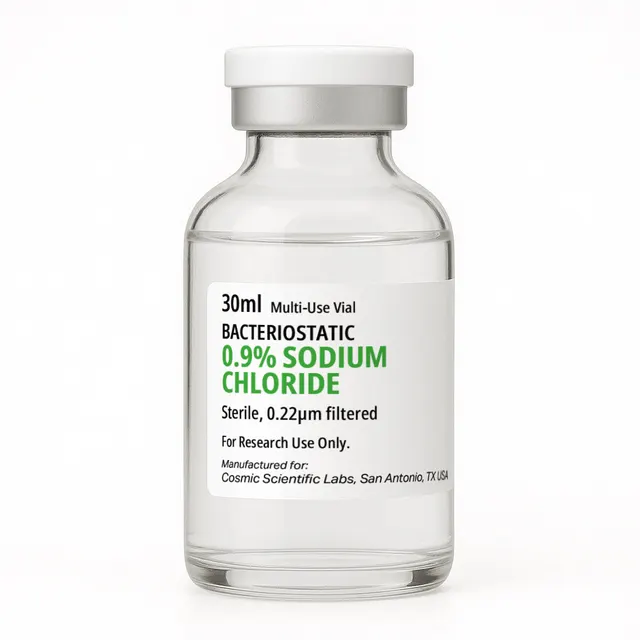
Bacteriostatic Saline - 30ml
Commonly researched with these items
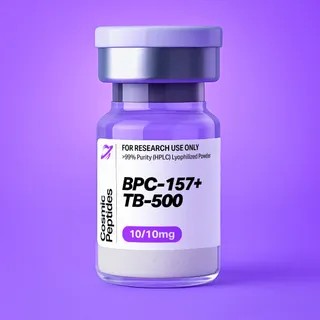
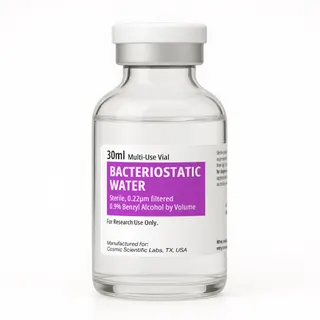
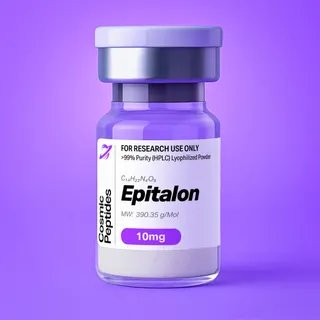
Patent-pending lot tracking: Complete transparency from production to vial.
Bacteriostatic Saline: 0.9% Sodium Chloride with 0.9% Benzyl Alcohol as a Preserved Aqueous Research Solvent
Disclaimer
Products described here are supplied for research use only and are not intended for diagnostic, therapeutic, or clinical application. All statements regarding biological activity reflect preclinical and in vitro findings exclusively and have not been evaluated by the U.S. Food and Drug Administration. These materials and related content are provided for educational and investigational purposes only and are intended solely for qualified researchers in laboratory and academic settings.
Key Facts
- Compound class
- Research solvent: 0.9% (154 mmol/L) aqueous sodium chloride preserved with benzyl alcohol (a three-component mixture, not a single compound)
- Sequence / structure
- Not applicable (no peptide sequence). Components: sodium chloride (NaCl), benzyl alcohol (C6H5CH2OH) and water (H2O)
- Nominal composition
- Sodium chloride 0.9% w/v (9 mg/mL; 154 mmol/L) and benzyl alcohol 0.9% (about 9 mg/mL; about 83 mmol/L) in high-purity water
- Molecular formula
- Mixture; components NaCl, C7H8O and H2O
- Molecular weight
- Mixture; components 58.44 g/mol (NaCl), 108.14 g/mol (benzyl alcohol), 18.015 g/mol (water)
- CAS number
- None for the mixture; components NaCl 7647-14-5, benzyl alcohol 100-51-6, water 7732-18-5
- PubChem CID
- Components: 5234 (sodium chloride), 244 (benzyl alcohol), 962 (water)
- Physical form as supplied
- Clear, colourless aqueous solution, 30 mL, in a sealed container
- Lot traceability
- Every unit is tied to a tracked lot; the lot number, recorded purity and verified quantity of the lot on sale are shown live on this page, with its certificate of analysis.
Molecular Identity and Classification
Bacteriostatic saline is an aqueous solution of sodium chloride at 0.9% weight per volume (9.0 g of NaCl per litre of solution) to which benzyl alcohol is added at 0.9% as an antimicrobial preservative. It is a defined mixture rather than a compound, so it has no single molecular formula, molecular weight or CAS number of its own; its chemical identity is fully described by the identities and concentrations of its three components. That is why the product fields on this page for CAS number, formula and molecular weight are empty, and why this section gives them per component.
The three components are sodium chloride (NaCl, CAS 7647-14-5, PubChem CID 5234, 58.44 g/mol), benzyl alcohol (phenylmethanol, C7H8O, CAS 100-51-6, PubChem CID 244, 108.14 g/mol, monoisotopic mass 108.0575 Da) and water (oxidane, H2O, CAS 7732-18-5, PubChem CID 962, 18.015 g/mol). Converted to molar terms, 9.0 g/L of NaCl is 0.1540 mol/L, so the solution contains 154 mmol/L of sodium ions and 154 mmol/L of chloride ions. Benzyl alcohol at 9.0 g/L is 83.2 mmol/L.
The word "bacteriostatic" is a chemical description of the preservative's action, not of the solution's use. A bacteriostatic agent inhibits the growth and multiplication of bacteria at the concentration used, as distinct from a bactericidal agent, which kills them outright. Benzyl alcohol at about 0.9% belongs to the first category: in a laboratory reagent that is opened and sampled more than once, it keeps low-level microbial contamination from growing in the solution between uses.
Its closest relatives are plain 0.9% sodium chloride (no preservative) and bacteriostatic water (the same preservative, no salt); the choice between them is a choice of ionic strength.
Structure and Chemical Features
Sodium chloride in water. Solid NaCl is an ionic lattice; in water it dissociates completely into hydrated Na+ and Cl− ions. At 154 mmol/L the ionic strength of the solution is 0.154 mol/L, because both ions are monovalent (I = ½ Σ cizi2 = ½ (0.154 + 0.154)). This single number governs most of what the salt does to dissolved peptides. It sets the Debye screening length, the distance over which an electric charge on a molecule is felt by other charges in the solution. At 25 °C the Debye length in nanometres is approximately 0.304 divided by the square root of the ionic strength, which gives about 0.78 nm for 0.154 mol/L. In carbon dioxide-equilibrated pure water, by contrast, the ionic strength is only in the micromolar range and the screening length is of the order of hundreds of nanometres. In practical terms, charged groups on a peptide dissolved in saline repel or attract one another only over distances comparable to a few bond lengths, while in water the same charges interact across the whole molecule and with neighbouring molecules.
Sodium and chloride also have specific, not merely electrostatic, interactions with water and with solutes. In the Hofmeister series, first established in the 1880s from the ability of salts to precipitate egg-white proteins, both Na+ and Cl− sit near the middle: they are neither strongly structure-making (kosmotropic) like sulfate nor strongly structure-breaking (chaotropic) like thiocyanate. Collins explained this behaviour in terms of ionic charge density and the strength of ion hydration, and Baldwin analysed how such specific ion effects influence protein stability. Because NaCl lies close to the neutral point of the series, at 0.154 mol/L its effect on most peptides is dominated by general charge screening rather than by strong specific salting-in or salting-out.
Benzyl alcohol. Benzyl alcohol is the simplest aromatic alcohol: a phenyl ring joined to a hydroxymethyl group (C6H5–CH2OH). The structure gives it a split personality that explains both its usefulness and its interactions. The phenyl ring is hydrophobic and polarizable, while the primary hydroxyl group is a hydrogen-bond donor and acceptor (one of each, by PubChem's count), giving a small topological polar surface area of 20.2 Å2 and a computed XLogP of 1.1. It is therefore moderately soluble in water (about 42.9 g/L at 25 °C and 35 g/L at 20 °C) and freely miscible with ethanol, ether and chloroform. At 9 g/L in this solvent it is present at about one fifth of its saturation concentration at 25 °C, so it stays fully dissolved across normal laboratory temperatures.
The hydroxyl group of benzyl alcohol is not acidic in any practical sense (pKa about 15.4), and the molecule has no basic group. It is therefore uncharged at every pH a laboratory solution will reach. This is a structure-property point with direct consequences: the activity of ionizable preservatives such as benzoic acid depends strongly on pH, because only the uncharged acid form partitions well into membranes, whereas benzyl alcohol keeps the same neutral form, and broadly similar behaviour, from acidic to mildly basic conditions.
The benzylic carbon, the CH2 group between the ring and the hydroxyl, is the chemically reactive position. Benzylic C–H bonds are weaker than ordinary alkyl C–H bonds because the radical formed by removing a hydrogen atom is stabilized by the aromatic ring. This makes benzyl alcohol susceptible to slow aerobic oxidation, first to benzaldehyde (C7H6O, CID 240, 106.12 g/mol) and then to benzoic acid (C7H6O2, CID 243, 122.12 g/mol). Abend and colleagues showed that benzaldehyde formed in this way can go on to react with benzyl alcohol to give benzaldehyde dibenzyl acetal under aerobic conditions. Benzaldehyde is the degradation product of most interest to peptide chemists, because aldehydes react reversibly with primary amines, such as a peptide's N-terminus or lysine side chains, to form imines (Schiff bases).
Synthesis and Manufacturing Chemistry
Sodium chloride for reagent and high-purity grades is obtained from rock salt or brine and purified by recrystallization, typically by vacuum evaporation, which reduces calcium, magnesium, sulfate, bromide, iodide and heavy-metal content. Divalent cations and trace metals matter to researchers because they can bind peptides or catalyse oxidation of susceptible residues.
Benzyl alcohol is manufactured industrially mainly by hydrolysis of benzyl chloride, itself made by side-chain chlorination of toluene; reduction of benzaldehyde is an alternative route. The related substances that grade specifications for benzyl alcohol control follow from this chemistry and from storage: benzaldehyde (from oxidation or incomplete reduction), residual benzyl chloride, dibenzyl ether (from condensation of two molecules of the alcohol) and other aromatic by-products.
Water for a solution of this kind is high-purity water produced by distillation or by reverse osmosis combined with ion exchange, with low conductivity, low total organic carbon and controlled microbial content.
Preparation follows a simple sequence: the salt is dissolved in most of the water, benzyl alcohol is added with mixing until fully dissolved (at 0.9% it dissolves completely, but it is denser than water and must be mixed in rather than left to settle), the volume is adjusted, the pH is checked and, if necessary, adjusted with dilute hydrochloric acid or sodium hydroxide, and the solution is passed through a 0.2 µm membrane filter before filling. Vials are closed with elastomeric stoppers and aluminium crimp seals. The solution contains no buffer, so its pH is that of the dissolved components in equilibrium with the air in the headspace.
One point of manufacturing chemistry is easy to overlook: the percentage of benzyl alcohol can be stated as weight per volume or as volume per volume. Because benzyl alcohol has a density of about 1.04 g/cm3, 0.9% v/v corresponds to about 9.4 mg/mL (86.7 mmol/L), while 0.9% w/v is exactly 9.0 mg/mL (83.2 mmol/L). The difference of roughly 4% is irrelevant for preservation but worth knowing when benzyl alcohol is quantified or used as an internal reference peak.
Analytical Characterization
Assays for the Solvent
Chloride and sodium. The classical assay for sodium chloride content is argentometric titration of chloride with silver nitrate, with potentiometric or indicator end-point detection; ion chromatography quantifies chloride and sodium separately and also detects other anions. Conductivity is a fast identity and concentration check: from the molar conductivity of NaCl at this concentration (roughly 105 S cm2 mol−1), a 154 mmol/L solution has a conductivity of about 16 mS/cm at 25 °C. Benzyl alcohol is uncharged and changes this value only slightly.
Benzyl alcohol. Benzyl alcohol is assayed by reversed-phase HPLC with UV detection near 254–257 nm, where the aromatic ring has a weak benzenoid absorption band, or by gas chromatography. The same HPLC run resolves benzaldehyde and benzoic acid, the oxidation products, which elute separately from the parent alcohol on C18 columns. A rising benzaldehyde peak is the most sensitive indicator that the preservative has been exposed to air or light over a long period.
pH and osmolality. pH is measured with a glass electrode; because the solution is unbuffered, readings drift as dissolved carbon dioxide equilibrates, and the specification range commonly quoted for preserved saline solvents of this type is wide (pH 4.5 to 7.0). Osmolality is measured by freezing-point osmometry and is close to 0.37 osmol/kg (see Worked Composition Calculations), with sodium chloride contributing about 0.29 osmol/kg and benzyl alcohol about 0.08 osmol/kg.
How the Solvent Appears in Peptide Analysis
UV absorbance. Benzyl alcohol absorbs strongly below about 220 nm and weakly near 257 nm. At 83 mmol/L, even a molar absorption coefficient of the order of 102 L mol−1 cm−1 at the 257 nm band gives an absorbance above 10 in a 1 cm cell, so a peptide solution made in this solvent cannot be quantified by direct UV absorbance against a water blank. Researchers either blank against the same lot of solvent, measure at wavelengths where the interference has been characterized, or quantify the peptide by a method that separates it first.
HPLC. When a peptide dissolved in bacteriostatic saline is loaded onto a reversed-phase column, benzyl alcohol gives a large, sharp peak, typically eluting at low to moderate acetonitrile content, and sodium chloride passes through at the void volume. Neither is an impurity of the peptide, and both should be excluded from peak-area purity calculations by running a solvent blank under the same gradient. Mant and colleagues review the reversed-phase conditions used for peptides, including detection at 210–220 nm, where the benzyl alcohol peak is at its largest.
Mass spectrometry. Non-volatile salt is the main analytical liability of saline in electrospray ionization. Sodium chloride at 154 mmol/L suppresses analyte ionization, as King and colleagues showed in their mechanistic study of ionization suppression, and it generates sodium adducts and salt clusters. The table below lists the ions a researcher should expect from the solvent and the mass shifts it introduces. Samples in saline are usually desalted by solid-phase extraction on C18 material, or diluted substantially, before LC-MS or direct infusion.
| Species | m/z or shift | Notes |
|---|---|---|
| Na+ | m/z 22.989 | Below the scan range of most peptide methods |
| Na(NaCl)+ | m/z 80.948 | First member of the sodium chloride cluster series |
| Na(NaCl)2+ | m/z 138.907 | Clusters repeat every 57.959 Da |
| Na(NaCl)3+ | m/z 196.865 | Chlorine isotopes add a pattern at +2 Da |
| Benzyl alcohol [M+H]+ | m/z 109.065 | Weak; the alcohol protonates poorly |
| Benzyl alcohol [M+H−H2O]+ | m/z 91.054 | C7H7+ (benzyl/tropylium cation), often the dominant benzyl alcohol ion |
| Benzyl alcohol [M+Na]+ | m/z 131.047 | Favoured in sodium-rich samples |
| Peptide [M+Na]+ versus [M+H]+ | +21.982 Da | Sodium replaces a proton; multiple sodium adducts add 21.982 Da each |
| Peptide [M+Cl]− (negative mode) | +34.969 Da relative to M | Paired with a 37Cl ion 1.997 Da higher at about one third of the intensity |
Physicochemical Properties
| Property | Value | Notes |
|---|---|---|
| Sodium chloride concentration | 9.0 g/L; 154 mmol/L | 9.0 g/L ÷ 58.44 g/mol |
| Benzyl alcohol concentration | 9.0 g/L; 83.2 mmol/L (w/v basis) | About 86.7 mmol/L if stated as 0.9% v/v |
| Ionic strength | 0.154 mol/L | Monovalent ions only; benzyl alcohol is uncharged |
| Debye screening length (25 °C) | about 0.78 nm | 0.304 nm ÷ √0.154 |
| Calculated osmolarity (ideal) | about 391 mOsm/L | 2 × 154 + 83 |
| Expected osmolality (real) | about 0.37 osmol/kg | NaCl osmotic coefficient about 0.93 (Hamer and Wu) |
| Freezing point | about −0.69 °C | 1.86 K kg/mol × 0.37 osmol/kg |
| Conductivity (25 °C) | about 16 mS/cm | Estimated from the molar conductivity of NaCl |
| pH | Unbuffered; commonly specified 4.5–7.0 | Drifts with dissolved CO2 |
| Density (20 °C) | about 1.005 g/mL | Dominated by the salt; benzyl alcohol adds little |
| Benzyl alcohol: formula / MW / monoisotopic mass | C7H8O / 108.14 g/mol / 108.0575 Da | PubChem CID 244 |
| Benzyl alcohol: water solubility | 42.9 g/L (25 °C); 35 g/L (20 °C) | The solvent holds about 21% of saturation at 25 °C |
| Benzyl alcohol: XLogP3 / TPSA | 1.1 / 20.2 Å2 | Amphiphilic; partitions into lipid bilayers |
| Benzyl alcohol: pKa | about 15.4 | Uncharged at all working pH values |
| Benzyl alcohol: boiling / melting point | 205 °C / −15 °C | Neat liquid; density about 1.04 g/cm3 |
| Sodium chloride: formula / MW | NaCl / 58.44 g/mol | PubChem CID 5234; monoisotopic mass 57.9586 Da |
Two properties in this table deserve emphasis. First, osmolality and tonicity are not the same thing. Benzyl alcohol contributes about 0.08 osmol/kg to the measured osmolality, but it is small, uncharged and membrane-permeant, so it equilibrates across cell membranes and does not hold water on one side of them. Only the salt, about 0.29 osmol/kg, behaves as an effectively impermeant solute. A freezing-point osmometer reports the total, which is why the measured osmolality of a preserved saline is noticeably higher than that of plain 0.9% sodium chloride even though the salt content is identical.
Second, the solution has essentially no buffer capacity. Anything dissolved in it, including a peptide supplied as a trifluoroacetate or acetate salt, sets the pH of the final solution. Where pH matters to an experiment, the peptide solution should be measured, or the peptide should be dissolved in a buffer instead.
Research Context
In the laboratory, bacteriostatic saline is used as a preserved diluent: a solvent for preparing aqueous stock solutions of peptides and other water-soluble research compounds that will be sampled from repeatedly over days or weeks. Its two active ingredients each change the chemistry of what is dissolved in it, and the literature on both is useful for designing experiments.
Ionic Strength and Peptide Behaviour
Dissolving a peptide in 154 mmol/L NaCl rather than in water screens its charges. For a highly charged, hydrophilic peptide the effect is usually small and benign. For peptides that carry several charges of the same sign together with hydrophobic segments, screening has two competing consequences. Electrostatic repulsion between molecules, which in pure water keeps them apart, is weakened, so self-association and aggregation can become more favourable; at the same time intramolecular repulsion is weakened, which can stabilize compact or helical conformations. Researchers working with amphipathic or aggregation-prone sequences therefore often dissolve the peptide in water first and add salt afterwards, or compare water and saline stocks directly.
Cationic antimicrobial peptides illustrate the conformational side clearly. Johansson and colleagues reported that the α-helical content of the cathelicidin peptide LL-37, measured by circular dichroism, depends on the ionic composition and pH of the solution, and linked conformation to activity in vitro. Ion-specific effects of this kind are the modern descendants of Hofmeister's observations, and the reviews by Kunz, Henle and Ninham (on Hofmeister's original papers) and by Zhang and Cremer (on the molecular mechanisms of the series) are good entry points for researchers who need to choose between salt solutions deliberately.
Benzyl Alcohol and Protein or Peptide Structure
Benzyl alcohol is not an inert spectator. A well-characterized body of biophysical work shows that it can induce partial unfolding and aggregation of proteins in solution. Zhang and colleagues studied the mechanism with recombinant interleukin-1 receptor antagonist and found that benzyl alcohol accelerated aggregation by perturbing tertiary structure and shifting the protein towards partially unfolded, aggregation-competent states without large changes in secondary structure. Hutchings and colleagues compared several antimicrobial preservatives and related their tendency to induce aggregation to their ability to populate partially unfolded states, and Bis and Mallela showed with interferon α-2a that the rank order in which preservatives induce aggregation is the same for different proteins.
For short peptides without a folded tertiary structure the concern is smaller, but the same physical chemistry applies: the phenyl ring of benzyl alcohol interacts with hydrophobic and aromatic side chains, and at 83 mmol/L the alcohol is present in large molar excess over a typical peptide stock (a 1 mg/mL solution of a 1,000 Da peptide is only 1 mmol/L). Researchers studying the conformation or self-assembly of a peptide by circular dichroism, fluorescence, light scattering or NMR should prepare a reference sample without preservative, for example in plain saline or water, and regard benzyl alcohol as an experimental variable rather than an assumption.
Benzyl Alcohol and Lipid Membranes
Benzyl alcohol partitions into lipid bilayers. Ebihara and colleagues compared its effects across several bilayer systems and showed that it alters bilayer properties, an observation that made benzyl alcohol a standard tool in membrane biophysics for increasing bilayer fluidity. The same membrane activity underlies its preservative action: disruption of microbial membrane integrity inhibits growth. For cell-based in vitro assays, it means that a compound dissolved in bacteriostatic saline brings a membrane-active solute with it. The amount reaching the cells depends entirely on the dilution into culture medium (see the table in the next section), and the appropriate control is a vehicle sample of the same solvent at the same dilution.
Worked Composition Calculations
Contents of one 30 mL vial. At 9.0 mg/mL, 30 mL contains 270 mg of sodium chloride (4.62 mmol), of which 106 mg is sodium and 164 mg is chloride, and about 270 mg of benzyl alcohol (2.50 mmol, roughly 0.26 mL of the neat liquid).
Osmolality. The molality of NaCl is close to 0.155 mol/kg. Hamer and Wu tabulate the osmotic coefficient of NaCl at 25 °C; at this molality it is about 0.93. The salt therefore contributes 2 × 0.155 × 0.93 ≈ 0.29 osmol/kg. Benzyl alcohol, a non-electrolyte at about 0.084 mol/kg, contributes about 0.08 osmol/kg. The sum, about 0.37 osmol/kg, predicts a freezing point near −0.69 °C, which is what an osmometer measures.
Dilution into an assay. When a stock made in bacteriostatic saline is diluted into a buffer or culture medium, the benzyl alcohol concentration falls in proportion. The table gives the values a researcher needs for a matched vehicle control.
| Dilution (stock : final volume) | Benzyl alcohol | NaCl contributed by the stock |
|---|---|---|
| 1 : 2 | 0.45%; 41.6 mmol/L | 77 mmol/L |
| 1 : 10 | 0.09%; 8.3 mmol/L | 15.4 mmol/L |
| 1 : 100 | 0.009%; 0.83 mmol/L | 1.54 mmol/L |
| 1 : 1,000 | 0.0009%; 83 µmol/L | 0.154 mmol/L |
| 1 : 10,000 | 0.00009%; 8.3 µmol/L | 15.4 µmol/L |
Molar excess over a peptide. For a peptide of molecular weight M (g/mol) dissolved at c mg/mL, the molar ratio of benzyl alcohol to peptide is 83.2 × M ÷ (1,000 × c). For a 1 mg/mL solution of a 342 g/mol tripeptide such as KPV the ratio is about 28 : 1; for a 1 mg/mL solution of a 4,493 g/mol peptide such as LL-37 it is about 370 : 1.
Bacteriostatic Saline or Bacteriostatic Water?
The two preserved solvents differ only in the presence of sodium chloride, and the choice between them is a decision about ionic strength.
| Property | Bacteriostatic saline | Bacteriostatic water |
|---|---|---|
| Sodium chloride | 0.9% (154 mmol/L) | None |
| Benzyl alcohol | 0.9% (about 83 mmol/L) | 0.9% (about 83 mmol/L) |
| Ionic strength | 0.154 mol/L | Near zero (from dissolved CO2 and the solute) |
| Debye length | about 0.8 nm | Hundreds of nanometres before the solute is added |
| Osmolality | about 0.37 osmol/kg | about 0.08 osmol/kg |
| Electrospray MS | Requires desalting; sodium adducts and clusters | Benzyl alcohol ions only; fewer adducts |
| Typical choice when | An ionic strength near 0.15 mol/L is wanted in the stock | Maximum solubility of charged or aggregation-prone peptides, or salt-sensitive analysis |
The shop also offers Bacteriostatic Water, 30 mL in glass, Bacteriostatic Water, 30 mL in HDPE and Bacteriostatic Water, 10 mL. Many researchers keep both solvents and decide per compound: water for the initial dissolution of a lyophilized peptide whose solubility is uncertain, saline when an ionic-strength-matched stock is wanted.
Glossary
- Ionic strength (I)
- Half the sum of each ion's molar concentration multiplied by the square of its charge. For 154 mmol/L NaCl it equals 0.154 mol/L.
- Debye length
- The characteristic distance over which an electrostatic charge is screened by the surrounding ions; about 0.78 nm in this solvent at 25 °C.
- Osmolarity and osmolality
- Osmotically active particles per litre of solution and per kilogram of water, respectively. Osmometers measure osmolality; the ideal osmolarity of this solvent (about 391 mOsm/L) overstates the measured osmolality (about 0.37 osmol/kg) because NaCl is not an ideal solute.
- Osmotic coefficient (φ)
- The ratio of a solution's real osmotic effect to that predicted for ideal behaviour; about 0.93 for NaCl at 0.155 mol/kg.
- Hofmeister series
- The ordering of ions by their ability to salt proteins out of or into solution; Na+ and Cl− sit near its neutral middle.
- Adduct ion
- An ion formed in a mass spectrometer when the analyte associates with another species, such as Na+ or Cl−, instead of, or in addition to, a proton.
Laboratory Handling and Storage
Storage of unopened vials. Keep vials at controlled room temperature (about 20–25 °C), upright and protected from light. Freezing is unnecessary and best avoided: ice formation concentrates the salt and the alcohol in the remaining liquid and can stress the closure. Light and oxygen drive the slow oxidation of benzyl alcohol to benzaldehyde, so vials should stay in their carton until use.
After opening. The preservative is intended to limit the growth of low-level contamination, not to compensate for poor technique. Dispense aliquots with clean laboratory technique, keep the container closed between uses, and record the date it was first opened. Laboratories commonly assign a fixed in-use period to opened reagents under their own quality procedures.
Dissolving peptides. Add the solvent slowly down the wall of the peptide vial rather than directly onto the powder, and swirl gently instead of shaking or vortexing, which can promote foaming and aggregation at the air–water interface. If a peptide dissolves poorly in saline, try water first and add salt afterwards, because ionic strength can lower the solubility of some charged, hydrophobic sequences. For quantitative work, correct the weighed peptide mass for peptide content and counterions.
Storage of peptide solutions made in this solvent. Store peptide stocks refrigerated (2–8 °C) for short periods or as frozen single-use aliquots for longer periods. Remember that benzaldehyde formed by slow oxidation of the preservative can react with free amines; for long-term storage of amine-rich peptides, or for any work where adducts would confuse the analysis, a preservative-free solvent and frozen aliquots are the cleaner choice. A +88.031 Da mass shift (addition of C7H4, the net change when benzaldehyde condenses with an amine to form an imine and loses water) is the signature to look for by LC-MS.
Container compatibility. Benzyl alcohol is a moderately good solvent for some plastics and can be absorbed by certain elastomers and polymers. Prolonged contact with soft plastics, such as some tubing or low-grade polystyrene ware, can lower the preservative concentration and leach additives into the solution. Glass, polypropylene and high-density polyethylene are the usual compatible materials.
Re-verification. Conductivity (about 16 mS/cm at 25 °C), pH, and benzyl alcohol and benzaldehyde content by HPLC-UV confirm the composition of an opened vial. Each lot's certificate of analysis, linked on this page, records the results for that lot.
Frequently Asked Research Questions
- What is bacteriostatic saline?
- Bacteriostatic saline is an aqueous solution of 0.9% w/v sodium chloride (154 mmol/L) containing 0.9% benzyl alcohol (about 83 mmol/L) as an antimicrobial preservative. In the laboratory it is used as a preserved diluent for preparing aqueous stock solutions of peptides and other water-soluble research compounds.
- Does bacteriostatic saline have a CAS number or molecular formula?
- No. It is a mixture, so it has no single CAS number, formula or molecular weight. Its components are sodium chloride (CAS 7647-14-5, NaCl, 58.44 g/mol), benzyl alcohol (CAS 100-51-6, C7H8O, 108.14 g/mol) and water (CAS 7732-18-5).
- What does "bacteriostatic" mean here?
- It means the benzyl alcohol inhibits bacterial growth at the concentration used rather than killing bacteria outright. Its role is to keep contamination introduced when the reagent is opened and sampled more than once from multiplying in the solution.
- How does bacteriostatic saline differ from bacteriostatic water?
- Both contain 0.9% benzyl alcohol; bacteriostatic saline also contains 0.9% sodium chloride. The salt raises the ionic strength from near zero to 0.154 mol/L, which screens charges on dissolved peptides, can change their solubility and conformation, and introduces sodium adducts in mass spectrometry.
- What is the osmolality of 0.9% sodium chloride with 0.9% benzyl alcohol?
- About 0.37 osmol/kg: roughly 0.29 osmol/kg from sodium chloride (with an osmotic coefficient of about 0.93) and about 0.08 osmol/kg from benzyl alcohol. Because benzyl alcohol crosses membranes, only the salt contributes to effective tonicity.
- Is bacteriostatic saline buffered?
- No. It contains no buffer, its pH is commonly specified between 4.5 and 7.0, and it drifts with dissolved carbon dioxide. The pH of a peptide solution made in it is set largely by the peptide and its counterion.
- Will benzyl alcohol show up in my HPLC chromatogram?
- Yes. Benzyl alcohol gives a large peak in reversed-phase HPLC with UV detection, especially at 210–220 nm. Run a solvent blank under the same gradient and exclude the benzyl alcohol peak (and any benzaldehyde or benzoic acid peaks) from the purity calculation of the dissolved peptide.
- Can I run LC-MS on a peptide dissolved in bacteriostatic saline?
- Yes, after desalting. Sodium chloride at 154 mmol/L suppresses electrospray ionization and produces [M+Na]+ adducts (+21.982 Da) and Na(NaCl)n+ clusters at m/z 80.948, 138.907 and 196.865. C18 solid-phase extraction or strong dilution before analysis avoids these problems.
- Can benzyl alcohol affect a peptide or protein in solution?
- It can. Biophysical studies show that benzyl alcohol induces partial unfolding and aggregation of several proteins, and its phenyl ring interacts with hydrophobic side chains. Its oxidation product benzaldehyde can form imines with free amines. For structural studies, a preservative-free control sample is recommended.
- How much benzyl alcohol reaches a cell culture well?
- It depends only on the dilution: a 1 : 100 dilution of the solvent gives 0.83 mmol/L (0.009%) benzyl alcohol and a 1 : 1,000 dilution gives 83 µmol/L. A vehicle control of the same solvent at the same dilution accounts for any effect of the preservative and the added salt.
- How should bacteriostatic saline be stored?
- Unopened vials at controlled room temperature, upright and protected from light; freezing is unnecessary. Once opened, date the container and use it within the in-use period set by the laboratory's quality procedures.
- Where can I see the analytical results for the lot I am buying?
- This page shows the lot number and verified quantity of the lot currently on sale, taken live from the shop's lot-tracking database, together with that lot's certificate of analysis.
Sources & Further Reading
- National Center for Biotechnology Information. PubChem Compound Summary for CID 244, Benzyl Alcohol. PubChem CID 244.
- National Center for Biotechnology Information. PubChem Compound Summary for CID 5234, Sodium Chloride. PubChem CID 5234.
- National Center for Biotechnology Information. PubChem Compound Summary for CID 962, Water. PubChem CID 962.
- National Center for Biotechnology Information. PubChem Compound Summary for CID 240, Benzaldehyde. PubChem CID 240.
- National Center for Biotechnology Information. PubChem Compound Summary for CID 243, Benzoic Acid. PubChem CID 243.
- Hamer WJ, Wu YC. Osmotic coefficients and mean activity coefficients of uni-univalent electrolytes in water at 25 °C. Journal of Physical and Chemical Reference Data 1972;1(4):1047–1100. doi:10.1063/1.3253108
- Kunz W, Henle J, Ninham BW. 'Zur Lehre von der Wirkung der Salze' (about the science of the effect of salts): Franz Hofmeister's historical papers. Current Opinion in Colloid & Interface Science 2004;9(1–2):19–37. doi:10.1016/j.cocis.2004.05.005
- Collins KD. Charge density-dependent strength of hydration and biological structure. Biophysical Journal 1997;72(1):65–76. doi:10.1016/S0006-3495(97)78647-8
- Baldwin RL. How Hofmeister ion interactions affect protein stability. Biophysical Journal 1996;71(4):2056–2063. doi:10.1016/S0006-3495(96)79404-3
- Zhang Y, Cremer PS. Interactions between macromolecules and ions: the Hofmeister series. Current Opinion in Chemical Biology 2006;10(6):658–663. doi:10.1016/j.cbpa.2006.09.020
- Abend AM, Chung L, Bibart RT, Brooks M, McCollum DG. Concerning the stability of benzyl alcohol: formation of benzaldehyde dibenzyl acetal under aerobic conditions. Journal of Pharmaceutical and Biomedical Analysis 2004;34(5):957–962. doi:10.1016/j.jpba.2003.11.007
- Zhang Y, Roy S, Jones LS, Krishnan S, Kerwin BA, Chang BS, Manning MC, Randolph TW, Carpenter JF. Mechanism for benzyl alcohol-induced aggregation of recombinant human interleukin-1 receptor antagonist in aqueous solution. Journal of Pharmaceutical Sciences 2004;93(12):3076–3089. doi:10.1002/jps.20219
- Hutchings RL, Singh SM, Cabello-Villegas J, Mallela KMG. Effect of antimicrobial preservatives on partial protein unfolding and aggregation. Journal of Pharmaceutical Sciences 2013;102(2):365–376. doi:10.1002/jps.23362
- Bis RL, Mallela KMG. Antimicrobial preservatives induce aggregation of interferon alpha-2a: the order in which preservatives induce protein aggregation is independent of the protein. International Journal of Pharmaceutics 2014;472(1–2):356–361. doi:10.1016/j.ijpharm.2014.06.044
- Ebihara L, Hall JE, MacDonald RC, McIntosh TJ, Simon SA. Effect of benzyl alcohol on lipid bilayers. A comparisons of bilayer systems. Biophysical Journal 1979;28(2):185–196. doi:10.1016/S0006-3495(79)85170-X
- King R, Bonfiglio R, Fernandez-Metzler C, Miller-Stein C, Olah T. Mechanistic investigation of ionization suppression in electrospray ionization. Journal of the American Society for Mass Spectrometry 2000;11(11):942–950. doi:10.1016/S1044-0305(00)00163-X
- Mant CT, Chen Y, Yan Z, Popa TV, Kovacs JM, Mills JB, Tripet BP, Hodges RS. HPLC analysis and purification of peptides. Methods in Molecular Biology 2007;386:3–55. doi:10.1007/978-1-59745-430-8_1
- Johansson J, Gudmundsson GH, Rottenberg ME, Berndt KD, Agerberth B. Conformation-dependent antibacterial activity of the naturally occurring human peptide LL-37. Journal of Biological Chemistry 1998;273(6):3718–3724. doi:10.1074/jbc.273.6.3718
Last reviewed:
| Lot Number | 26127 |
|---|
Cosmic Peptides Certificate of Analysis
Unable to load certificate. Download COA